
Outdoor flood lights are one of the quietest energy loads on a commercial site. They run from dusk to dawn, about 4,380 hours a year, more than double the hours of a typical office interior, and nobody watches the meter for them because the cost arrives inside one electricity bill. A building with twenty 400-watt metal halide floods on its yard and perimeter burns close to 40,000 kilowatt-hours a year on light that most staff never see.
Replacing those fixtures with LED flood lights is one of the few efficiency upgrades that pays back within a few years without changing how anyone works. The savings come from three places: fewer watts for the same light, hours trimmed by controls, and a far longer service life. This article puts numbers on each.
In This Article:
Where the energy goes
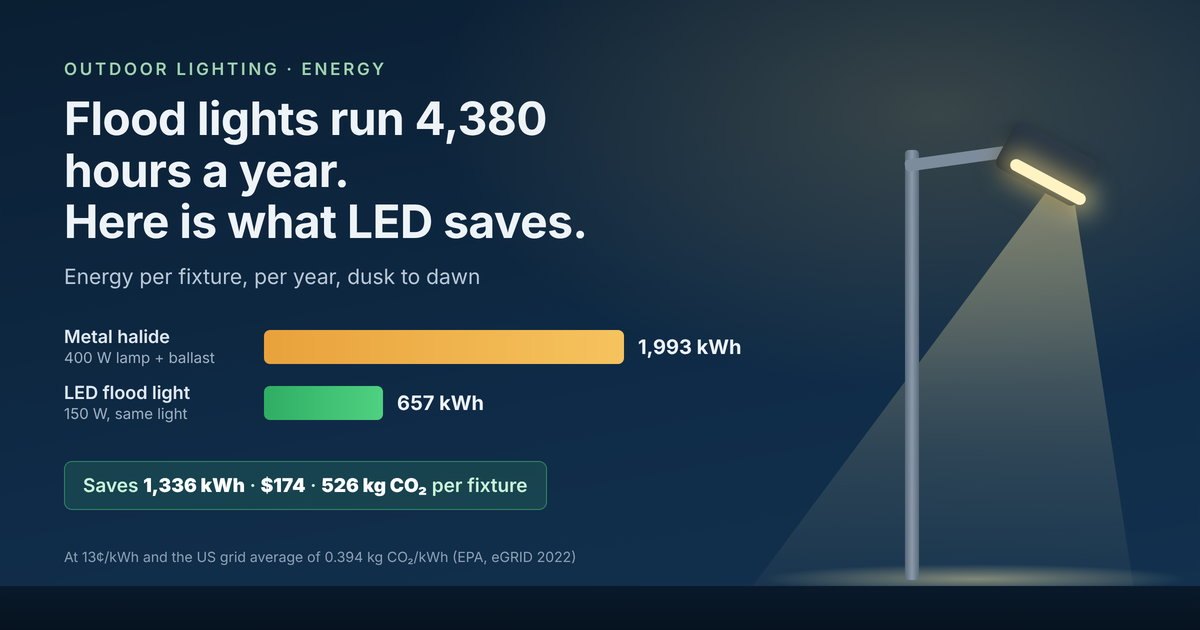
Lighting energy is watts multiplied by hours, and outdoor lighting loses on both. A 400-watt metal halide lamp draws about 455 watts once its ballast is counted, so the ballast alone adds roughly 12 percent before any light is made. Multiply by 4,380 hours and one fixture uses close to 2,000 kilowatt-hours a year. And because metal halide lamps lose up to a third of their output as they age, most sites end up running more of them than the site needs.
Even a larger LED fixture undercuts that. A 300-watt unit such as the FL5 300W LED flood light delivers 45,000 lumens, about what a 400-watt metal halide lamp produces when new and more than one a few years old, from 155 fewer watts and no ballast. Match the light instead of the wattage and the gap widens further, as the next section shows.
Why LED delivers the same light for fewer watts
Efficacy, lumens delivered per watt consumed, is where the gap opens. Once ballast losses and lumen depreciation are counted, a metal halide system delivers roughly 60 to 80 lumens per watt. A current LED flood delivers 130 to 150. That is why a 150-watt LED flood is the standard replacement for a 400-watt metal halide fixture.
LED fixtures also aim their light. The chips face the ground behind an optic, while a metal halide lamp radiates in every direction and relies on a reflector to send some of it back down. More of the LED’s lumens land where they are needed, so fewer are needed in the first place.
A worked example
Take one 400-watt metal halide flood replaced by a 150-watt LED, both running dusk to dawn. Electricity is priced at 13 cents per kilowatt-hour; use your own rate. Carbon uses the US grid average of 0.394 kg of CO2 per kilowatt-hour from the EPA’s equivalencies calculator (eGRID 2022).
| Per fixture, per year | Metal halide 400W | LED 150W | Saving |
| Input power | 455 W | 150 W | 305 W |
| Energy | 1,993 kWh | 657 kWh | 1,336 kWh |
| Cost at 13¢/kWh | $259 | $85 | $174 |
| CO2 | 785 kg | 259 kg | 526 kg |
Across twenty fixtures that is about 26,700 kilowatt-hours, roughly $3,500 and 10.5 tonnes of CO2 a year. At those numbers a fixture usually pays for itself in one to three years, depending on the price paid and any utility rebate.
What to look for on the spec sheet
Four lines on a spec sheet decide most of the running cost: lumens per watt, a DLC listing, rated life, and dimming. Lumens per watt should be 130 or better. A DLC listing means the efficacy and life claims were verified by the DesignLights Consortium, and it is what most utility rebate programs require. Rated life is usually given as L70, the hours until output falls to 70 percent. Dimming on 0–10V or 1–10V lets controls cut output after hours.
The FL5 sheet above is a good example of a complete one: 45,000 lumens, 150 lumens per watt, a DLC listing, 1–10V dimming, an IP65 rating and 120–277V input, all on one page. Retailers such as Green Light Depot publish these figures and the DLC status on the product page, so candidates can be compared before anyone asks for a quote.
Controls: the hours you stop paying for
A photocell switches fixtures with daylight and removes the human error of a timer left on winter hours in June. Timers suit sites with fixed closing times. Dimming does the most: dropping a 150-watt fixture to half output for six of its twelve hours saves about 164 kilowatt-hours a year, another 25 percent off its bill, while keeping enough light for cameras. In yards with little traffic, motion sensors go further still.
Lifespan, maintenance and disposal
Metal halide lamps are rated for roughly 10,000 to 20,000 hours, so a dusk-to-dawn site replaces them every two to four years, usually from a bucket truck. The spent lamps contain mercury and belong in a lamp-recycling stream, not a dumpster.
An LED flood rated L70 at 50,000 hours runs about eleven years at twelve hours a night, and DLC-listed fixtures usually carry a five-year warranty. Over that period the avoided truck rolls, lamps and ballasts are a real part of the savings, even if they never show on the electricity bill.
Rebates and a short checklist
Many utilities pay rebates on DLC-listed LED fixtures, and some require approval before purchase, so check the program first. Then confirm:
- Current fixture wattage, including ballast, and nightly hours
- Replacement lumens matched to the mounting height, not the old wattage
- 130 lumens per watt or better, with a DLC listing
- A photocell, timer or dimming plan for every fixture
- Service voltage: 120–277V or 480V
- A recycling route for the old lamps
Done this way, an outdoor lighting retrofit cuts a load that runs 4,380 hours a year by roughly two-thirds, and it keeps cutting it for a decade.
FAQS:
How much electricity does a 300-watt LED flood light use?
About 3.6 kilowatt-hours a night at twelve hours, or roughly 1,314 kilowatt-hours a year. At 13 cents per kilowatt-hour that is about $171 a year, and around 518 kg of CO2 at the US grid average.
What size LED replaces a 400-watt metal halide flood?
A 150-watt LED flood in most cases. Match the lumens delivered to the pavement, not the old wattage, and check the mounting height before you pick a size.
Do LED flood lights work with a photocell or timer?
Yes. Many have a built-in photocell; others ship with a shorting cap and accept a twist-lock photocell. Fixtures with 0–10V or 1–10V dimming also work with timers and lighting controllers.
How long do LED flood lights last?
Fixtures rated L70 at 50,000 hours keep at least 70 percent of their output for about eleven years at twelve hours a night. DLC-listed fixtures usually carry a five-year warranty.
Are LED flood lights eligible for utility rebates?
Often, if the fixture is DLC listed. Some programs require approval before purchase, so check with the utility before ordering