
Battery backup has gained real traction over the last several years. Costs have come down, technology has improved, and outages have become harder to ignore. Aging grid infrastructure and more frequent severe weather have made power failures more disruptive and less predictable than they used to be.
People come to battery backup for different reasons. Some want to keep their home livable during outages. Others rely on uninterrupted power for medical equipment, refrigeration, or business operations. Many now work from home and cannot afford repeated interruptions. The reasons vary, but when the grid goes down, the power still must be there.
Every home and small business uses power differently, so a reliable system should be designed with engineering expertise. This guide explains how to evaluate both the system and the installer behind it.
What a Battery Backup System Does

A battery backup system stores energy and supplies power when utility service is interrupted. Depending on the design, batteries can recharge from the grid, from solar, from a generator, or from a combination of those sources. They operate quietly, require relatively little maintenance, and switch over almost instantly when an outage occurs.
The most important design decision is not the battery brand. It is deciding what actually needs to stay powered when the grid is unavailable.
Partial Backup Systems
Many homes and small businesses only need to support a limited set of critical loads. These commonly include refrigeration, internet and communications, essential lighting, security systems, medical devices, gas furnace blowers, or sump and well pumps.
A properly engineered partial backup system concentrates battery capacity and inverter output on those circuits. Because fewer loads are supported, these systems are typically smaller, more cost-effective, and easier to manage while still providing meaningful protection.
With a solid recharge plan, partial backup systems can remain operational for days or weeks. The key is careful circuit selection. High-demand equipment such as electric ovens, dishwashers, large water heaters, or other 240-volt appliances can drain batteries quickly if included without controls. Managing this requires selective circuit design or load management based on a real load assessment, not assumptions.
Whole-Home or Whole-Building Backup
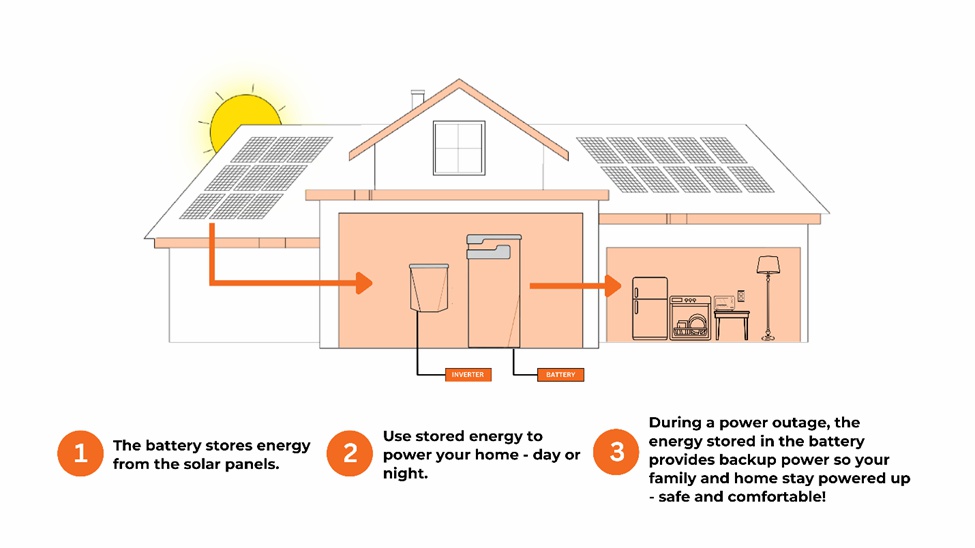
Whole-home or whole-building battery systems allow most circuits to remain available during an outage, but that does not mean everything can operate at the same time.
Battery and inverter systems have defined power limits. A qualified designer must evaluate both energy capacity and output capability to determine how many large loads can run simultaneously without overloading the system. Heating, cooking, pumps, and other high-demand equipment often need to be sequenced or shed automatically to maintain stable operation.
For businesses, this analysis becomes even more specific. A clear load profile is necessary to keep critical operations powered while nonessential loads are controlled. These systems require larger batteries and greater upfront investment, but when designed correctly, they provide flexibility and continuity that simpler systems cannot.
Load Management and Why It Matters
One of the biggest differences between installers is their ability to design and commission load management correctly.
In standard systems, selected circuits are wired into a backup panel and remain powered during an outage. These circuits are chosen during design and do not change automatically. High-demand appliances are excluded to preserve battery capacity. When designed properly, these systems are straightforward and reliable.
Smart load systems use intelligent panels or controllers to monitor and manage circuits in real time. Essential loads remain powered automatically, while nonessential loads are shed as needed to prevent overload and extend runtime. These systems adapt based on battery charge, solar production, and generator availability.
Even with smart controls, energy still has limits. High-demand loads may be temporarily disabled to protect the system. A competent installer explains how this works upfront so performance during an outage matches expectations.
Understanding Runtime
Battery capacity is often the first thing people focus on, but capacity alone does not determine how long a system will perform.
Runtime depends on battery capacity, power output, load behavior, and how the system recharges. Real homes and businesses do not draw power evenly. Motors have startup surges. Loads cycle on and off. Usage changes throughout the day.
Good system design accounts for these realities. The goal is not just to survive the first few hours of an outage, but to remain functional over multiple days. That requires evaluating peak demand, startup behavior, and realistic usage patterns, along with a plan for restoring energy consistently.
Recharge Planning
A resilient battery backup system must be evaluated over days and weeks, not hours. True reliability depends on restoring battery energy day after day during an outage.
Solar recharge allows batteries to replenish automatically when sunlight is available. When designed realistically, solar can dramatically extend runtime for critical loads during much of the year.
Generator recharge provides dependable recovery when solar production is limited. In well-integrated systems, the generator runs only when batteries need charging, reducing fuel use and wear. This is especially valuable during winter storms and prolonged outages.
Hybrid systems combine solar, batteries, and generators. Solar handles daily energy needs when possible, while the generator provides backup during low-sun or high-demand periods. This configuration offers the highest level of flexibility and long-term resilience.

Evaluating the Installer
Battery backup systems are permanent electrical infrastructure. Long-term performance depends far more on engineering and execution than on the battery brand itself.
A qualified installer takes time to understand how your home or business operates, which loads matter most, and how outages affect you. Installers who lead with equipment recommendations before addressing those realities are selling products, not designing systems.
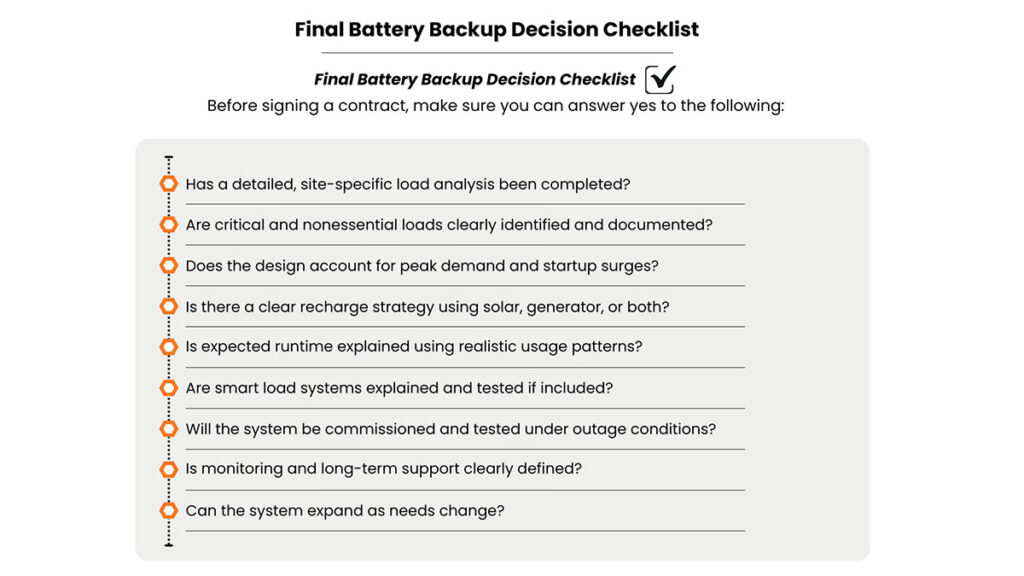
A documented load analysis should be part of the process. It should identify continuous loads, intermittent loads, and startup surges, and explain how those loads interact. The installer should be able to explain design decisions clearly and support the system after installation, including commissioning and outage testing.
Conclusion
Battery backup is an investment in reliability, not a reaction to the last outage. When engineered properly, it becomes a quiet system you rarely think about until the grid fails.
The right installer designs for real-world conditions, explains tradeoffs clearly, and supports the system over time. Choosing carefully at the beginning leads to better performance and fewer surprises when you need power the most.