
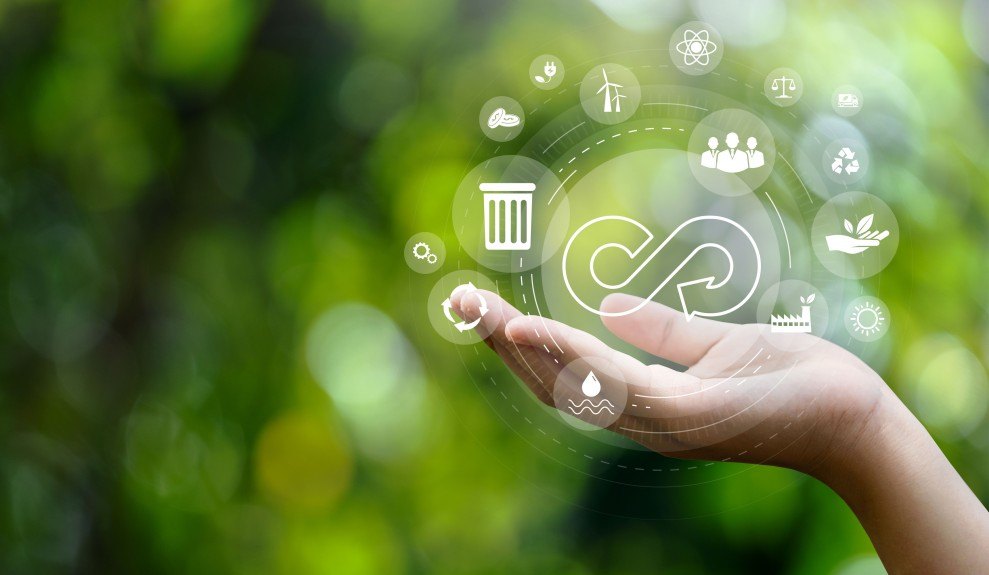
The circular bioeconomy is not a slogan. It is a working framework for aligning resource use with the natural cycles that sustain modern economies. Rather than following the linear pattern of extract, use, and discard, circular systems treat outputs from one process as inputs to the next. In an era of intensifying pressure on freshwater supplies, arable land, and finite mineral reserves, this shift from linear to circular thinking has become central to how climate-resilient societies are designed. The tools required are increasingly available; the harder work is the conceptual reframing that treats every material stream as a potential resource rather than an inevitable disposal cost.
In This Article:
The linear system and its accumulated costs
For most of the twentieth century, sustainability was treated as an add-on to a fundamentally linear economy — a matter of managing pollution rather than redesigning material flows. The costs of that approach have accumulated visibly: soil degradation across major food-producing regions, aquifer depletion under intensive irrigation, greenhouse gas emissions from organic material that was once biologically active, and rising carbon intensity as easily accessible mineral reserves are drawn down. A linear system pays these costs at the end. A circular system is designed to avoid incurring them in the first place, by keeping biological and material flows in productive use for as long as possible.
Soil, fertilizers, and food systems
Modern food systems depend heavily on synthetic fertilizers, and their production is among the most energy- and carbon-intensive links in global agriculture. Phosphorus, mined from a small number of geological deposits, is a finite resource on a human timescale, and excess nitrogen drives eutrophication in rivers, lakes, and coastal waters. A circular approach seeks to close these gaps by recovering plant-available compounds from residual streams — food waste, agricultural byproducts, livestock manure, and other biological materials — and returning them to soil in stabilized forms. Soils benefit directly from the return of organic matter, which improves water retention, microbial diversity, and long-term productivity. Restoring soil health is one of the few climate strategies that also directly strengthens the food system depending on it.
Small-scale sanitation as a working example
A useful illustration at the household scale is the composting toilet. Instead of flushing organic material into diluted wastewater streams that then require centralized treatment, composting systems process it through controlled aerobic decomposition, producing a stabilized humus and a liquid fraction that can safely return to soil after appropriate storage periods. Modern designs from manufacturers such as TROBOLO and others in this segment make the approach viable for households, off-grid sites, and mobile applications — capturing organic material that centralized systems typically lose, eliminating the water demand of conventional flushing, and reducing the load on downstream infrastructure. It is a small-scale application of a principle that scales upward across many sectors.
Water as a circular resource
Water follows a parallel logic. Centralized treatment infrastructure works by dilution: mixing usable water with contaminants and then spending energy to separate them again. Decentralized systems that avoid mixing streams in the first place — greywater reuse, rainwater harvesting, and localized industrial recycling — reduce both freshwater demand and the treatment burden downstream. Membrane technologies, constructed wetlands, and biological treatment loops have become more capable and less expensive year over year. In water-stressed regions, this is not merely an efficiency question. It is an adaptation question that determines whether communities can maintain agriculture, industry, and household use under mounting climate volatility.
Bio-based materials and biogenic energy
The circular bioeconomy extends well beyond soil and water flows. Timber and pulp byproducts move into biomaterials and construction rather than landfill. Agricultural residues — corn stover, rice husks, sugarcane bagasse — become feedstock for biogas, biochar, and bio-based chemicals. Waste cooking oil is refined into biodiesel. Anaerobic digestion recovers energy from streams that would otherwise release methane into the atmosphere. Each of these applications displaces a fossil-based counterpart while capturing value from a stream that would otherwise represent a pure disposal cost. Taken together, they demonstrate that the same underlying principle applies across dozens of industries and material types, not merely a handful of specialized ones.
A wider network of circular applications
Small-scale sanitation is one node in a much larger network. Urban food waste feeds industrial composting operations and energy recovery plants. Livestock manure supports biogas generation and soil amendment. Textile fibers are increasingly cycled through mechanical or chemical recycling, and construction materials find second uses in the built environment. Historically, the economics were the barrier — landfill and incineration were cheaper than recovery — but the cost curve is shifting as carbon pricing, virgin-material scarcity, and regulatory pressure accumulate. Circular systems are moving from niche demonstrations to mainstream infrastructure decisions across sectors as different as agriculture, wastewater, packaging, and construction.
The mindset shift
The technical solutions exist and are maturing. The larger transition is one of perspective: recognizing that “waste” is a category we invented, and that most streams society treats as disposable contain resources worth recovering. As bioeconomy strategies mature and climate pressures accelerate, closing these loops is becoming less an environmental aspiration and more a basic condition of resilient infrastructure — aligning material systems with the biological and physical realities that will define the coming decades.