
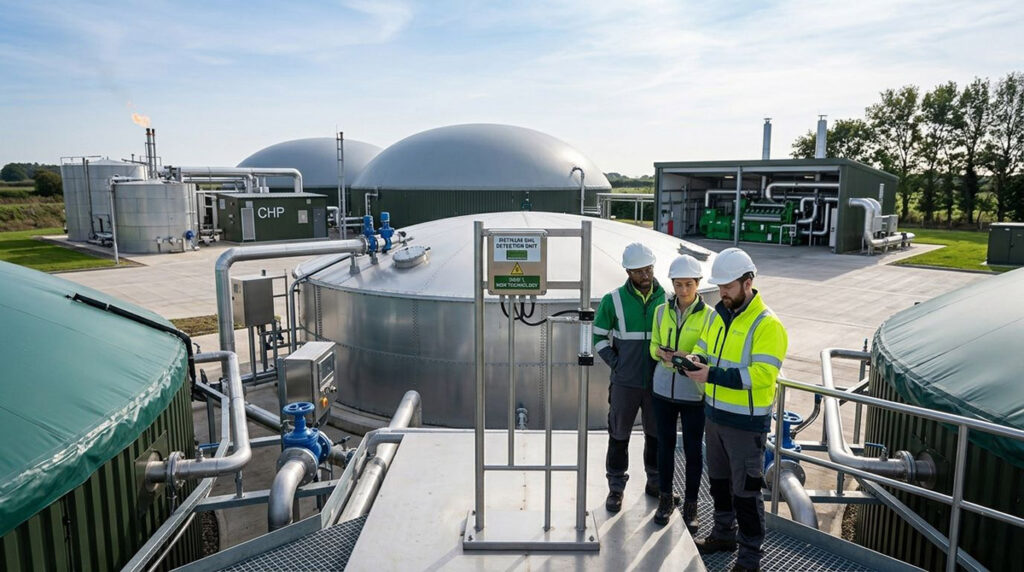
Anaerobic digestion (AD) and biogas facilities are increasingly central to the global shift toward sustainable, low-carbon energy. As governments and industries set ambitious renewable energy targets, the number of operational biogas plants has grown substantially across agriculture, wastewater treatment, and industrial waste management sectors.
Methane leaks in biogas facilities are not just an environmental problem. Methane is flammable between 5% and 15% in air — a range that is easy to reach in enclosed plant areas — and undetected leaks at pipeline joints, digester access points, or CHP engine rooms have caused fires and explosions at operational sites. Selecting the right CH4 gas detector is not a procurement formality. It determines whether a leak becomes a near-miss or an incident.
In this article:
Why Methane Detection Matters in Biogas Plants
Biogas is typically 50–70% methane, with the remainder being CO2, water vapor, H2S, ammonia, and siloxanes. That mixture matters for methane detector selection because H2S and siloxanes are the primary causes of sensor degradation — they poison catalytic bead sensors and foul optical windows in ways that are not always visible until the sensor has already stopped working reliably.
Key risk zones in a typical biogas facility include:
- Digester tank rooftops and dome access points
- Pipeline joints, flanges, and valve assemblies
- Agitator shaft seals and pump connections
- Gas storage balloon or pressurized tank perimeters
- Combined heat and power (CHP) engine rooms
These are not theoretical risk points — sensor failures and undetected leaks in these locations have resulted in fires, explosions, and regulatory violations at operating facilities.
Regulatory and Safety Requirements
The baseline requirement for any detector installed in a Zone 1 or Zone 2 area is ATEX certification (Europe) or IECEx (international), both grounded in IEC 60079. Without this, regulatory approval and site insurance are off the table. Beyond that, regional standards diverge: U.S. facilities must comply with OSHA and NFPA 820; European sites fall under EN 60079-29. For plants where detector output triggers automatic shutdown, a SIL 1 or SIL 2 rating under IEC 61511 may also be required.
Key Selection Criteria
Five criteria consistently separate well-specified CH4 gas detectors from underperforming ones in biogas environments:
- Sensor Technology, Selectivity, and Measurement Range: The sensing principle must reliably distinguish CH4 from H2S, humidity, and CO2 — all present in raw biogas. Cross-sensitivity is the most common cause of false alarms and missed events. Verify the measurement range covers your application: 0–100% LEL for explosion risk monitoring, and/or 0–100% VOL for confined space entry or process optimization. A T90 response time under 30 seconds is the practical benchmark for safety-critical zones.
- Environmental Durability and Deployment Format: Biogas environments combine high humidity, corrosive H2S, ammonia, and wide temperature swings. Detectors must meet at minimum IP66 ingress protection and be rated for -20°C to +55°C operation. Consider deployment format alongside durability: fixed CH4 gas detectors provide continuous 24/7 coverage at high-risk points, while portable units are indispensable for maintenance personnel in confined spaces. Most facilities benefit from both.
- Lifecycle Cost and Maintenance Burden: Purchase price is a poor proxy for true cost. Evaluate total cost of ownership (TCO) over five years: calibration frequency and consumables, sensor replacement intervals, spare parts logistics, and the operational cost of downtime. A well-specified detector requiring semi-annual calibration typically delivers lower TCO than a cheaper unit that demands monthly intervention — or fails under H2S exposure within its first year.
- System Integration and Connectivity: Methane gas detectors that cannot communicate with plant control systems add manual monitoring overhead and create alarm chain gaps. Confirm compatibility with standard protocols — 4–20 mA analog, Modbus RTU/TCP, or HART — and assess whether the unit can be incorporated into your existing SCADA, DCS, or IoT monitoring platform. Wireless capability is increasingly relevant for remote or hard-to-wire installations.
Technology Comparison: Which CH4 Detector Is Best for Your Facility?
Selecting the right sensing technology is the most consequential decision in the procurement process. The table below compares the five main technologies commonly deployed in biogas and AD environments:
| Technology | Pros | Cons | Best For |
| Catalytic Bead (LEL) | Low cost, fast response, simple to install | Easily poisoned by H2S & silicones; needs frequent calibration | Low H2S environments, budget-limited sites |
| Infrared (NDIR) | High selectivity, immune to H2S/humidity, long sensor life | Higher upfront cost, optical window needs cleaning | Typical biogas plants (Recommended) |
| Metal Oxide Semiconductor | Very low cost, broad detection range | High cross-sensitivity, temperature drift | Auxiliary/non-critical zone monitoring |
| Laser (TDLAS) | Ultra-high selectivity, remote/non-contact, minimal maintenance | High initial investment | Large facilities, long-distance pipeline monitoring |
| Electrochemical (Multi-gas) | Simultaneous LEL+ H2S + O2 detection | Shorter sensor lifespan, regular replacement required | Sites requiring multi-hazard monitoring |
Analysis and Recommendations
When NDIR is the Default
If your facility operates on raw or partially treated biogas — meaning H2S levels are not consistently controlled below 100 ppm — NDIR is the only defensible default. Do not start with catalytic bead and plan to “monitor performance.” H2S poisoning is cumulative and silent; by the time the sensor fails to alarm, you have already lost the protection window. NDIR detectors are inherently immune to the H2S and siloxane poisoning that rapidly degrades catalytic bead sensors in biogas environments. While the upfront cost is higher, the elimination of frequent sensor replacement and the reduction in false alarm incidents typically yields a more favorable TCO over a 3–5 year horizon.
As noted by the engineering team at GasDog, “When selecting a detector, decision-makers must prioritize the sensor’s drift rate in high H2S environments; our field data confirms that NDIR technology consistently outperforms thermal or catalytic methods in maintenance-free intervals.”
When Catalytic Bead is Acceptable
Catalytic bead sensors are only appropriate where all of the following are true: the biogas has passed through active desulfurization, H2S in the target zone is confirmed and consistently low, and your team has a fixed calibration schedule it will actually follow. If any of these conditions is uncertain, the lower purchase price is not a saving — it is a deferred cost with a worse failure mode. A poisoned catalytic bead sensor does not trip an alarm. It quietly loses sensitivity while appearing to function normally. You will not know it has failed until you need it to work.
When TDLAS is Justified
TDLAS fits one specific situation: pipeline runs or open areas too large or inaccessible for practical point detector coverage — where running cable to enough fixed units would be prohibitively expensive, or where physical access for routine maintenance is genuinely restricted. If your facility does not meet that description, the capital cost of TDLAS will not be recovered through maintenance savings within a standard asset lifecycle. Default to NDIR point detectors. Being newer and more sophisticated is not a procurement justification.
Fixed and Portable: Both are Required
A hybrid approach is strongly recommended for most facility types: fixed NDIR or TDLAS detectors for continuous perimeter and process monitoring, combined with portable multi-gas detectors (LEL + H2S + O2) for personnel safety during maintenance and confined space entry.
Conclusion
Methane gas detector in biogas and AD facilities is a multi-dimensional procurement decision that directly affects site safety, regulatory compliance, and operational economics.
As biogas production scales globally, the case for investing in reliable, well-specified methane detection systems becomes clearer: the cost of a single preventable incident — in equipment damage, downtime, regulatory fines, and reputational harm — invariably exceeds the price differential between a basic sensor and a purpose-engineered solution. Evaluate total cost of ownership, not just the line-item price, and match the technology to the environment it will serve.