
TL;DR
- B20 contains 6% to 20% biodiesel and carries 1% to 2% less energy per gallon than petroleum diesel. It is a fuel swap, not a change of technology.
- Most small recreational boats do not run diesel at all. They run petrol outboards, which no biodiesel blend can help.
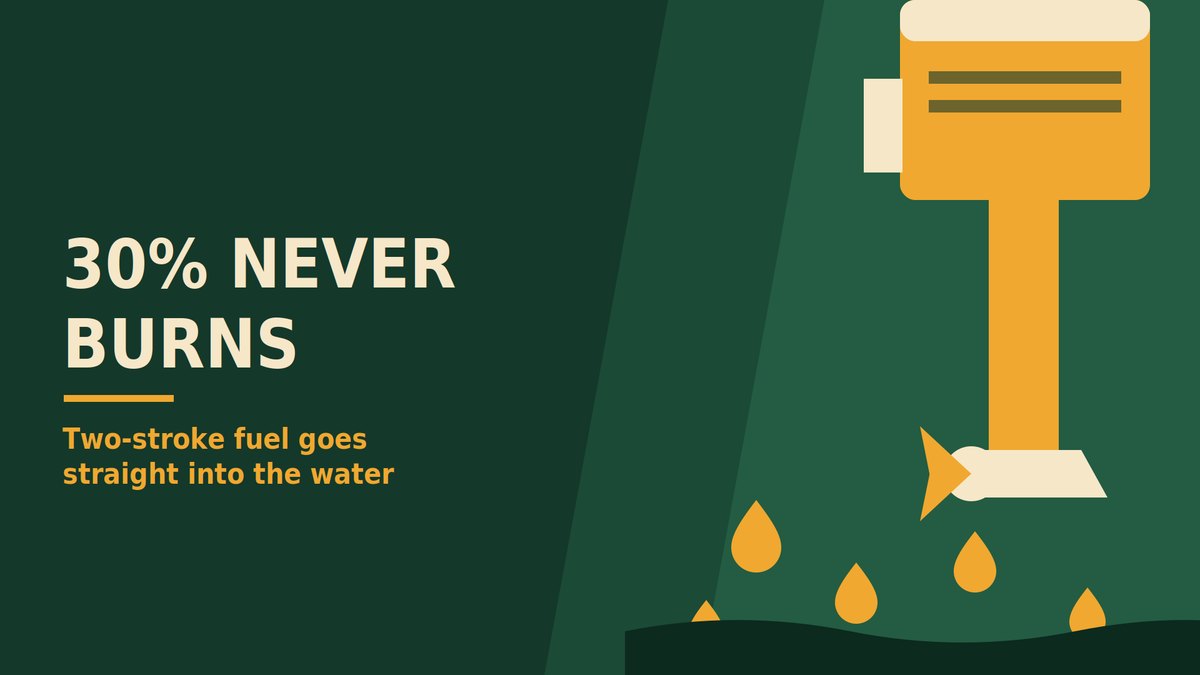
- A carbureted two-stroke engine can emit 25% to 30% of its fuel unburned into the water or the air.
- A 2,000W electric outboard weighing 16.53 lbs covers hulls to 5 m and 700 kg, which is the size band where most of that unburned fuel goes into the water.
Short version: biofuel is the right answer for the large diesel hulls and the wrong answer for the small petrol ones, and it is the small petrol ones that pollute worst per litre burned.
The two decarbonisation routes for boats are usually presented as competitors, which obscures the fact that they apply to different vessels. Drop-in biofuels work where there is a compression-ignition engine to put them in, and where the range requirement rules out batteries. Electrification works where the duty cycle is short and the hull is light. Small recreational boats sit awkwardly between the two, and the reason is that most of them burn petrol, not diesel.
In This Article:
Small boats sit in the gap between the two answers
A tender, a dinghy or a small fishing skiff typically carries a petrol outboard between 2 and 10 horsepower. There is no diesel engine, so there is no biodiesel pathway. The realistic fuel-side improvements are narrow: a cleaner four-stroke, better fuel handling, ethanol-tolerant components.
Electrification, by contrast, fits this class unusually well. Duty cycles are short, speeds are low, and the boats return to a dock with power every night. An electric outboard motor in this class weighs a fraction of the engine it replaces and clamps to the transom without drilling.
| Class | Power | Petrol equivalent | Thrust | Weight | Hull length | Load |
| 24V | 700W | 2 HP | 60 lbs | 13.45 lbs | 2.5 to 4.0 m | 350 kg |
| 48V | 2,000W | 5 HP | 120 lbs | 16.53 lbs | 3 to 5 m | 700 kg |
A 16.53 lb motor is a different object from a 5 HP petrol outboard, which is typically three to four times that weight and has to be carried with fuel. For a small boat launched off a trailer or a beach, that changes what one person can do alone.
What B20 actually delivers
Where there is a diesel engine, biodiesel is a serious option and the specifications are mature. The US Department of Energy’s Alternative Fuels Data Center defines B20 as a blend of 6% to 20% biodiesel, covered by ASTM D7467, with B100 covered by ASTM D6751 and conventional diesel under ASTM D975 permitting up to B5. B20 with the full 20% biodiesel content carries 1% to 2% less energy per gallon than petroleum diesel.
The known handling issues are worth naming plainly. B100 has a solvent effect that can lift deposits out of an existing fuel system and clog filters at first. High-level blends can gel in cold temperatures, may affect engine warranties, and can increase nitrogen oxide emissions. None of these are disqualifying, and all of them are reasons the industry settled on B20 as the practical middle rather than pushing to B100.
For a workboat, a ferry or a commercial fishing vessel with a diesel main engine, that is a genuine and immediate reduction with no capital cost. For a 4 metre skiff it is irrelevant.
The two-stroke problem no fuel blend solves
The pollution intensity of small petrol outboards is not a rounding error against larger vessels. California State Parks, in its guidance on two-stroke vessel engines, states that a carbureted two-stroke engine can emit up to 25 to 30 percent of its fuel unburned into the water or atmosphere. The California Air Resources Board phased in emission standards for new marine petrol two-stroke engines in 2001, 2004 and 2008, expecting a 30 ton per day reduction in hydrocarbons and oxides of nitrogen by 2010 and 44 tons per day by 2020. Those standards applied to new engines sold from 2001 and did not require retrofit or replacement of older engines already in use.
That last clause is the whole problem. Pre-2001 carbureted two-strokes remain legal and remain in service, discharging a quarter or more of their fuel directly into freshwater and near-shore environments. A blended fuel cannot fix an engine that fails to burn what it is given.
Matching the answer to the hull
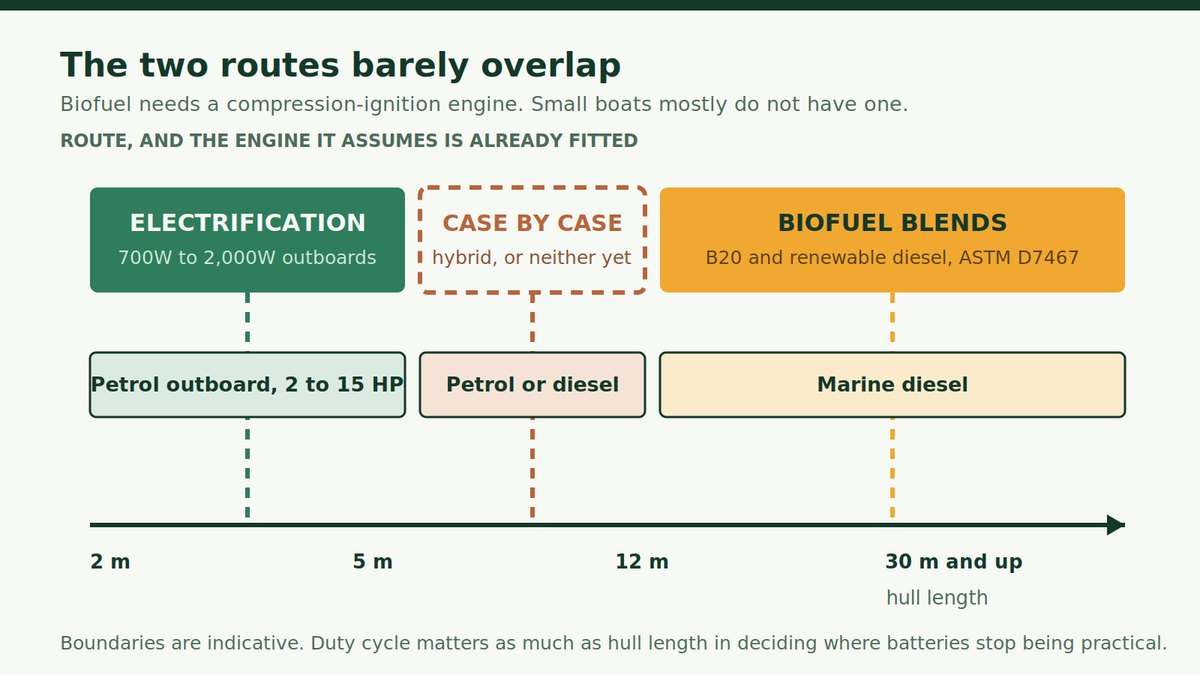
The routes barely overlap. Most disagreement about which is better comes from arguing across different rows.
| Vessel | Typical engine | Best current route |
| Tender, dinghy, inflatable to 4 m | Petrol outboard, 2 to 5 HP | Electrification |
| Small skiff or aluminium boat, 4 to 5 m | Petrol outboard, 5 to 15 HP | Electrification for short duty cycles |
| Larger recreational, 6 to 12 m | Petrol or small diesel | Case by case; hybrid or renewable diesel |
| Workboat, ferry, fishing vessel | Marine diesel | Biodiesel or renewable diesel blends |
| Ocean-going commercial | Large marine diesel | Advanced biofuels, methanol, ammonia |
Two answers to two different problems
The volumetric argument that governs solid biomass logistics has a marine parallel: what constrains a solution is rarely the headline number. Anyone who has followed the reasoning in why biomass freight is a volume problem, not a weight problem will recognise the shape of it. Energy density decides where batteries stop being sensible, and that boundary falls somewhere around hull length and duty cycle rather than around any statement about which technology is cleaner.
For policy purposes the useful framing is not biofuel versus electric. It is that the small petrol fleet has been left out of both conversations, is disproportionately dirty per litre, and happens to be the fleet where the electric option is already technically and commercially straightforward. That is an unusually easy gap to close, and it is currently being closed by individual buyers rather than by policy.