

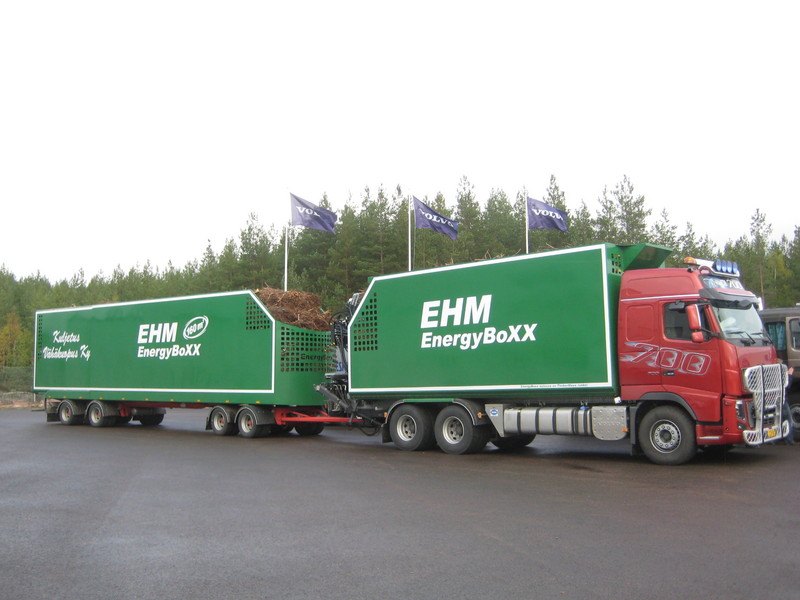
Two trucks leave the same industrial park under the same road limits. One carries bagged cement and reaches its legal weight with the trailer half empty. The other carries wood chips, fills the trailer to the roof, and still has several tonnes of payload in reserve. The first weighs out, the second cubes out — and almost every solid biomass supply chain belongs to the second category.
The arithmetic is simple. A 53-foot dry van has just under 4,000 cubic feet of capacity and, under an 80,000-pound gross vehicle weight limit, carries roughly 45,000 pounds of cargo. By dividing the payload by space, you get a break-even density near 11 pounds per cubic foot, or about 180 kilograms per cubic meter. Denser cargo exhausts the weight allowance first and lighter cargo the space first, which puts solid biofuels on opposite sides of the same line: graded wood pellets, specified under ISO 17225-2 at bulk densities of 600 kg/m³ and above, sit well clear of it, while baled straw at 100 to 160 kg/m³ falls below, and loose agricultural residues lower still. Wood chips sit between roughly 150 and 300 kg/m³, depending on species and moisture, so the same material can cube out on one delivery and weigh out on the next.
The consequence is that a trailer of straw may deliver a third of the tonnage a trailer of pellets delivers over the same route, burning comparable fuel and paying the same driver. Cost and emissions per tonne of feedstock — and per gigajoule of delivered energy — are therefore fixed by the physical form of the material long before anyone chooses a fuel or a route. It is one reason the efficiency question recurs in balanced assessments of biomass as an energy source: energy spent moving feedstock is a direct deduction from the energy that feedstock eventually yields.
Load factors that conceal the constraint
Freight planning conventionally reports a load factor — cargo weight divided by the vehicle’s weight capacity — which measures utilization reasonably well for dense goods but misleads for low-density biomass, where a physically full trailer can register a load factor of 0.4 and appear to have room it does not have. When the binding constraint is volumetric, utilization must be judged against deck volume as well as payload, which means establishing the trailer’s internal capacity in cubic feet and comparing it to the actual bulk or stacked volume loaded.
The distinction carries measurable commercial weight: a study reported by Omidkar et al. in 2025 considered more than 25,000 European road transport orders placed between 2021 and 2023. The authors found that three factors explain most of the cost of a biomass shipment: the type of vehicle used, the distance covered, and how fully the truck is loaded, which account for roughly 31%, 25%, and 12% of the price differences between shipments. A machine-learning model built on those factors reproduced about 95% of that variation on shipments it had not been trained on. The same study found that cost per tonne falls as load factor rises, with diminishing returns beyond full utilization — so where volume caps the achievable load factor, that lever is largely unavailable, leaving the operator to adjust distance and vehicle choice instead.
How freight markets price low-density
Road tariffs already encode the penalty. Under the US National Motor Freight Classification, shipments are assigned to one of eighteen classes according to density, from the lowest class covering cargo above 50 pounds per cubic foot to the highest covering cargo under one pound per cubic foot, with rates per pound rising as density falls. Pellets near 37 lb/ft³ land around class 55. Chips near 11 lb/ft³ fall close to class 92.5. Baled straw around 8 lb/ft³ sits near class 110. By determining your shipment’s exact freight classification, you can translate its density into a precise shipping rate—revealing exactly how much you are paying for every cubic meter of empty space.
Design responses
Three responses dominate practice, and each is a volume intervention rather than a fuel intervention.
The first is densification. Pelletizing raises bulk density by a factor of three or four at an energy cost of roughly 2–3% of the pellet’s own energy content, which is recovered over any haul long enough to matter. Briquetting and baling do less but cost less.
The second is drying. Moisture adds mass without adding energy, and green chips at 45% moisture carry roughly as much water as fiber over the same kilometers, while also lowering the net calorific value of what arrives.
The third is sitting. Studies of small-scale agroforestry chains have found economic feasibility concentrated within roughly 20 kilometers of the conversion point, which argues for distributed collection depots that densify locally before any long-haul leg begins. Depots also decouple harvest timing from plant demand, much like pairing generation with storage and smart dispatch decouples output from consumption on the electricity side.
Measure the space, not only the mass
The practical recommendation is unglamorous: record dimensions alongside weight for every consignment, and report utilization on both. Most feedstock procurement systems capture tonnage because tonnage is what gets paid for. Volume determines how many trucks run, and therefore how much of the delivered energy is consumed in getting the material to the gate.
Notably, the transport cost literature is still largely silent on the emissions side of this. The investigation of Omidkar et al. cited above optimizes cost and explicitly flags the absence of a life-cycle assessment of transport emissions as a gap for future work. Until that gap closes, bulk density remains the most reliable available proxy for how efficiently a biomass supply chain moves — and the cheapest variable to improve.