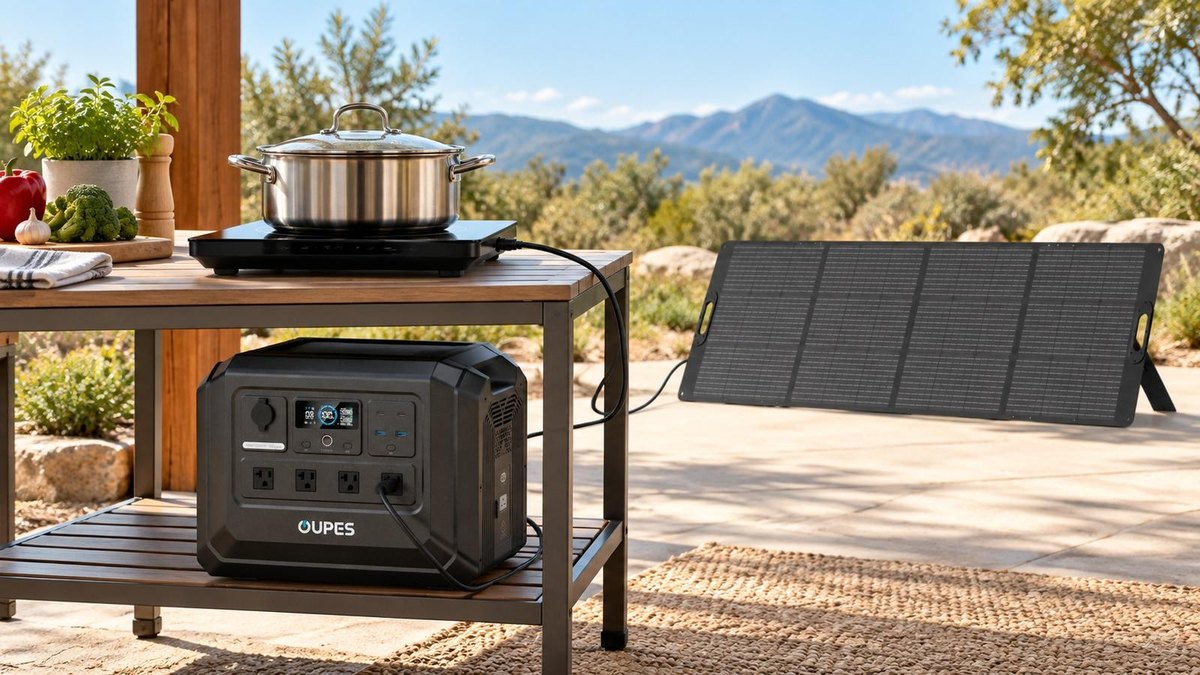

To run a refrigerator and a separate freezer, a solar generator needs enough output to handle their compressor starts and enough battery capacity for the outage you want to cover. In the worked example below, roughly 1.5–2kWh of rated capacity covers a 12-hour estimate, while around 3kWh covers 24 hours.
Those figures apply to the example appliances, not every household. A small chest freezer and an efficient refrigerator can have very different requirements from an older refrigerator paired with a large upright freezer in a warm garage.
In This Article:
Calculate Their Combined Energy Use
Start with how much electricity both appliances use over time. This determines the battery capacity you need.
The yellow EnergyGuide label lists estimated annual electricity use in kilowatt-hours. You can also find this information in the manufacturer’s specifications.
For an initial daily estimate:
Daily energy use = annual kWh ÷ 365
Suppose the refrigerator is rated at 450kWh per year and the separate freezer at 300kWh per year.
| Appliance | Illustrative annual energy use | Estimated daily energy use |
| Refrigerator | 450kWh | 1.23kWh |
| Separate freezer | 300kWh | 0.82kWh |
| Combined | 750kWh | 2.05kWh |
This example represents about 2,050Wh per day at the appliances.
If the freezer compartment is already part of the refrigerator, do not count it again as a separate appliance. The refrigerator’s annual energy figure covers that complete unit.
A daily measurement gives you a better starting point
EnergyGuide figures are estimates under standardized conditions. Your appliances may consume more or less at home.
For accessible plug-in appliances, a suitably rated energy meter can record consumption over 24–48 hours. Measure both appliances during normal use, following the meter’s instructions and the appliance’s electrical requirements.
This captures compressor cycling and other operating loads more effectively than checking the watts displayed at one moment.
A warm garage deserves particular attention. A freezer measured during mild weather may need more energy during a summer outage, when the space around it is considerably hotter.
Convert Energy Demand Into Battery Capacity
Rated battery capacity is not the same as energy delivered through the AC outlets. Conversion losses and the power station’s own operation consume some energy.
For this worked estimate, assume 80% of rated capacity reaches the appliances, then add a separate 200Wh reserve of rated battery capacity. These are planning assumptions, not a universal efficiency rating or a measured result for a particular model.
Estimated rated capacity = appliance energy ÷ 0.80 + 200Wh
| Backup period | Estimated appliance energy | Calculated rated capacity with the stated allowances |
| 12 hours | About 1,027Wh | About 1,484Wh |
| 24 hours | About 2,055Wh | About 2,768Wh |
For this pair, that points toward approximately 1.5–2kWh for an overnight estimate and around 3kWh for a full day.
The 12-hour figure is half the estimated daily consumption. Actual consumption during a particular night will vary with compressor cycles, defrost operation, temperature, and door use.
If reliable testing provides a model’s delivered AC energy under a comparable load, use that figure instead. Do not deduct conversion losses again from an already measured AC-capacity result.
A solar generator in the 3kWh class could therefore satisfy this example’s storage estimate. It still needs suitable output to start both appliances.
Check Compressor Starting Requirements Separately
A refrigerator or freezer can require a brief increase in power when its compressor starts. Battery capacity alone does not establish whether the power station can supply that increase.
Consider these illustrative appliance specifications:
| Appliance | Running power | Total power during startup |
| Refrigerator | 150W | 700W |
| Freezer | 100W | 600W |
Their combined running load would be 250W. When the refrigerator starts while the freezer is running, demand would be approximately 800W. When the freezer starts while the refrigerator is running, it would be about 750W.
If both starts overlap, the assumed combined demand would reach 1,300W.
Actual requirements depend on the appliances. Obtain starting information from the manufacturer or have it measured with equipment capable of capturing inrush. A general plug-in energy meter may record daily consumption accurately while missing a brief starting peak.
Check the power station’s supported surge duration and motor compatibility, as well as its headline peak wattage. An overload-assistance mode that reduces voltage is not automatically suitable for a compressor.
Connecting the appliances one at a time can reduce the first startup overlap. It does not prevent their compressors from restarting independently later.
Decide Whether Solar Charging Must Extend the Backup
For one overnight outage, stored battery energy may be your main concern. If you want both appliances running through the following day, solar recovery becomes part of the sizing decision.
In this example, the appliances consume about 2.05kWh each day. The panels must replace that energy, plus charging and operating losses, to maintain the battery’s charge over repeated days.
A panel’s rated wattage cannot tell you by itself whether that will happen. Available sun, shade, season, placement, and charging limits all matter. The refrigerator and freezer also continue using energy while the battery is charging, so incoming solar power is not all available for increasing the charge level.
Treat expected solar production as a separate daily energy estimate rather than assuming that a panel bundle guarantees continuous operation.
Confirm the Setup Before Relying on It
Run both appliances together through several normal compressor cycles and observe battery consumption. A short successful startup confirms only part of the job.
If the selected model has an AC output auto-off function, check the relevant settings in its manual before powering the refrigerator and freezer.
The right size is the smallest system that starts your actual appliances reliably and covers your chosen outage period with a reasonable reserve. For the example here, around 3kWh is a practical full-day starting point; your appliances’ measured consumption is what makes that estimate useful for your home.