
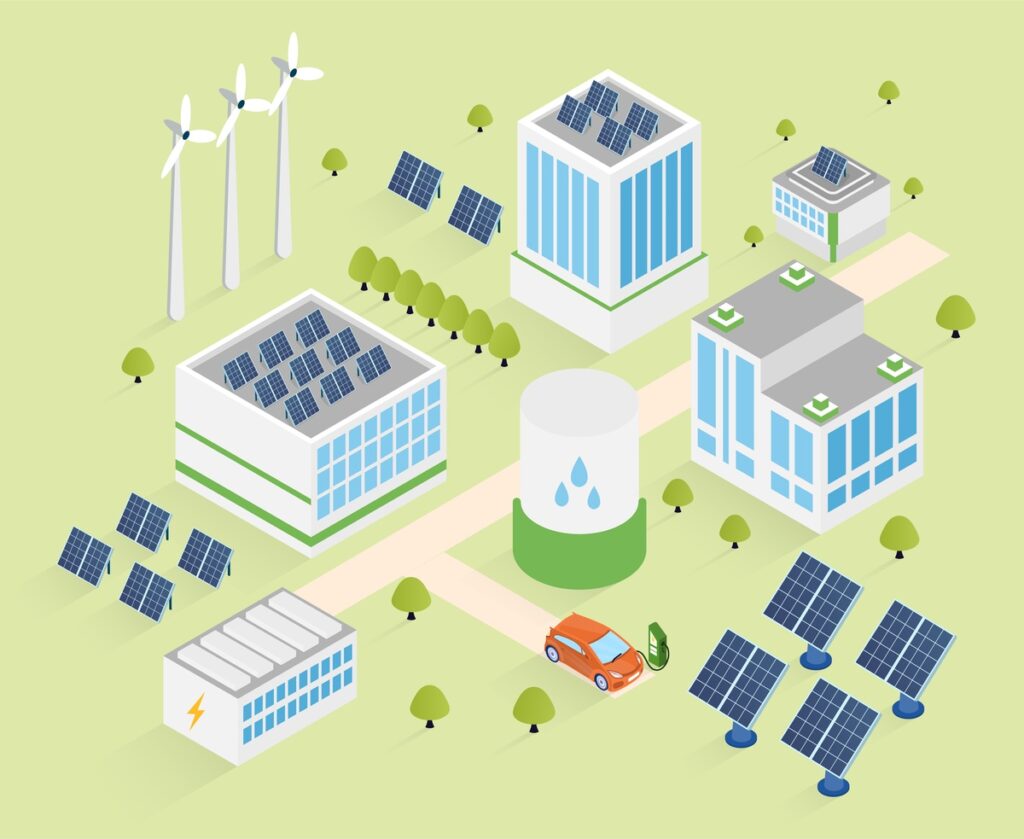
In the era of accelerating climate change, volatile energy markets and increasing demands for resilient and inclusive energy access, the pathway to a sustainable energy future must embrace more than isolated technologies.
For many regions, especially in developing countries and remote communities, the classic model of biomass-based energy systems remains vital. At the same time, innovations in electricity storage and smart grids rapidly broaden the options for how bioenergy can be integrated into broader systems.
This article explores how bioenergy solutions and battery storage can complement each other to enhance energy security, flexibility and sustainability – including cost dynamics, policy implications, and practical deployment steps for a just energy transition.
In this article:
Bioenergy’s enduring relevance in the energy mix
Bioenergy remains a key pillar of the clean energy transition. The Global Bioenergy Partnership emphasises that bioenergy can significantly contribute to energy access, climate change mitigation and food and energy security.
For many rural or off-grid contexts, biomass (solid, liquid or gaseous) remains one of the few locally available energy sources, offering opportunities for heat, power and transport applications.
Well-designed bioenergy systems can deliver multiple co‐benefits: supporting rural livelihoods, creating value in local supply chains, reducing dependency on fossil fuels, and improving energy resilience.
However, there are vital challenges: making supply chains sustainable, avoiding competition with food or land use, limiting lifecycle greenhouse gas (GHG) emissions, and integrating bioenergy into evolving grid systems. The GBEP Sustainability Indicators provide a valuable framework for assessing these dimensions.
The central question then becomes: as national grids become smarter and more decentralised, how can bioenergy keep pace – and indeed take advantage of – the evolving energy ecosystem?
The answer increasingly lies in coupling biomass or bio-gas systems with smart electrical storage and dispatch technologies.
Why storage matters – and how bioenergy can benefit
Electricity systems are rapidly shifting from a one-way, centralised model to more dynamic, flexible, and distributed architectures.
Renewable power (wind, solar) is variable, and increased electrification of heat, transport and industry places new demands on grid flexibility.
Storage thus becomes a critical component to stabilise supply and demand, manage peak loads, respond to “dark doldrums” (periods of low solar/wind output) and enable greater local autonomy.
Bioenergy systems can play a central role in this evolving paradigm:
- Dispatchable power – Biomass and biogas systems can provide dispatchable (on-demand) power when variable renewables falter. This dispatchability is increasingly valuable in grid systems characterised by high penetration of solar/wind.
- Hybrid systems with storage – Pairing bioenergy with battery or thermal storage enables even greater flexibility: for example, a biogas plant could run during low-cost hours and store electricity or heat for peak periods; or a biomass CHP (combined heat & power) unit can operate in tandem with battery storage to smooth output and provide grid services.
- Resilience and micro-grids – In remote or rural communities, bioenergy + storage combinations can deliver reliable local grids that are less vulnerable to large‐scale grid disruptions, extreme weather events or fuel supply shocks.
- Energy arbitrage and optimisation – With smart control systems, stored energy can be dispatched when market or tariff conditions are favourable – reducing costs and improving the economics of bioenergy systems.
These opportunities are compelling, but they also depend on cost drivers, business models and regulatory frameworks.
Cost dynamics: what storage does to the equation
To illustrate the role of storage from a cost perspective, consider the example of household-scale battery systems. While households are not the primary domain of most bioenergy projects, the cost trends and tariff-arbitrage dynamics are instructive.
According to SolarAdvice’s analysis of the Tesla Powerwall in the UK, the effective cost per cycle and payback period depend heavily on tariff structures, depth of discharge, and the lifecycle of the battery.
Key findings highlight that:
- Capital cost remains a major barrier: although battery prices have dropped substantially, installed household systems remain relatively expensive.
- The value of storage is strongly affected by tariff design and time-of-use differentials: more significant price spread between off-peak and peak improves payback.
- Lifetime and warranty matter: deeper cycles, larger installations and better degradation profiles all improve returns.
When transferring this thinking to bioenergy systems at larger scales, the following cost considerations emerge:
- The addition of battery or thermal storage increases capital costs, but the marginal benefit can be large – smoother output, higher value dispatch windows, grid service revenues, or improved utilisation of the bioenergy plant.
- If a bioenergy plant can reduce its running periods to coincide with favourable conditions (e.g., cheaper fuel, lower regulatory burden, or higher electricity price), the effective levelised cost of electricity/heat from biomass improves.
- The coupling of storage offers an economic lever: instead of selling power only when available, the system can “time-shift” production or dispatch, capturing higher value periods or avoiding low-value hours – boosting overall project economics.
Thus, policy frameworks and tariff designs that reward flexibility and storage can significantly enhance the business case for bioenergy + storage hybrids.
Policy and project-design implications for sustainable bioenergy
For policy-makers, funders and project developers working in the bioenergy domain, a few implications are especially noteworthy:
- Incentivise flexibility: Rather than simply incentivising capacity (MW) of bio-plants, policy frameworks should reward flexibility, dispatchability and responsiveness. This means recognising the value of storage and hybrid systems in grid operations.
- Design tariffs that support temporal arbitrage: Time-of-use tariffs, peak-shaving subsidies, or reward mechanisms for supply during high-demand windows help unlock the value of storage. The household battery example from SolarAdvice underscores the importance of tariff spread for economics.
- Integrate sector-coupling: Bioenergy plants can serve multiple vectors (electricity, heat, transport) and when paired with storage, can manage cross-vector optimisation (e.g., store heat when electricity prices are low, dispatch when high). This increases system efficiency and improves sustainability.
- Support hybrid system financing: Developers may face higher initial capital when adding storage. Providing de-risking tools (e.g., grants, soft loans, guarantees) for the storage component allows bioenergy systems to scale more rapidly.
- Prioritise sustainability indicators throughout: The deployment of expansion bioenergy + storage should align with the GBEP Sustainability Indicators (land, water, biodiversity, GHG, socio-economic, etc.). Hybrid systems should not lead to hidden unsustainable trade-offs.
- Ensure inclusive access and local benefit: For many regions in the GBEP network – especially developing nations – local ownership, community-based models and livelihood integration are key. Storage enables more autonomous micro‐grids, local energy trading and increased resilience, which can empower communities rather than leave them dependent solely on central grids.
Practical pathways: four deployment archetypes
Here are four practical archetypes for how bioenergy + storage might be implemented:
- Rural micro-grid with biomass + battery
A village in a developing country uses locally sourced agricultural residues or wood-chips feeding a 1-MW biomass generator. A battery storage unit (~500 kWh) is added to smooth output when demand peaks in the evening. The system enables the micro-grid to meet base load with biomass and handle peaks with battery, improving reliability and reducing diesel‐genset backup. - Industrial bio-plant with thermal storage and grid services
An agro-processing facility runs a biogas plant producing electricity and heat. Adding a thermal store (e.g., molten salt or steam buffer) and an electrical battery allows the plant to shift dispatch: generate electricity during off-peak hours, store heat for daytime process use, and sell grid services (frequency/voltage regulation) when prices are high. - Municipal waste-to-energy plant with energy arbitrage
A municipality operates a waste-to-energy (WtE) plant generating electricity. With added battery storage the plant dispatches power into the grid at premium hours or participates in demand-response programmes, increasing net revenue and improving the return on the waste-to-energy investment. - Agricultural biomass + community storage hub for off-grid electrification
A farming cooperative installs an anaerobic digester turning manure and crop residues into biogas, generating electricity. A bank of batteries and smart controls allow the community to manage intra‐day load, sell surplus to neighbouring grid when possible, and build resilience against power cuts.
In each case, the addition of storage unlocks enhanced value for the bioenergy asset, and offers improved flexibility, resilience and business case robustness.
Risks, barriers and mitigation
It is important to recognise the risks and barriers:
- Upfront cost and financing: Storage adds cost and risk. Mitigation: access to concessional finance, blended funding, risk-sharing mechanisms.
- Technology mismatch: If the storage is oversized or undersized relative to the bio-plant, the benefits diminish. Careful system design and simulation are vital.
- Regulatory barriers: In many jurisdictions storage and hybrid systems lack clear regulatory frameworks or market compensation. Mitigation: design policy that recognises storage value (e.g., ancillary services revenue, time-shift premiums).
- Sustainability trade-offs: Bioenergy supply chains must remain sustainable; adding storage doesn’t remove the need for land-use, biodiversity or GHG due-diligence. Mitigation: adhere to GBEP indicators, robust monitoring and reporting.
- Operational complexity: Hybrid systems are more complex (plant + storage + controls). Mitigation: ensure operational capacity building, training, and robust O&M frameworks.
Conclusion: A holistic ecosystem approach
The transition to sustainable energy is not about selecting one technology over another – but about designing systems that integrate across vectors, temporal scales, and value chains.
Bioenergy remains a critical pillar – particularly for many communities and countries where biomass is locally available and domestic resources matter. But to truly unlock its potential in a modern grid, it must partner with storage, controls, and smart dispatch strategies.
The household battery cost analysis referenced from SolarAdvice (citing the Tesla Powerwall) serves as a valuable micro-scale analogy: the economics of storage revolve around timing, tariff differentials, and system design.
Those same principles scale up to bioenergy systems and demand that project developers, policymakers and financiers recognise and reward flexibility, hybridisation and system thinking.
For stakeholders in the GBEP community – whether you’re working on biomass supply chains, bio-gas, waste-to-energy or hybrid micro-grids – now is the moment to explore storage integration, refine business models that value time-shifts and grid services, and ensure that sustainable bioenergy continues to evolve in step with the broader energy system.
With well-designed hybrid bioenergy + storage systems, we can deliver clean, reliable, locally-clipped energy solutions – support sustainable development, empower rural communities, enhance resilience, and meet climate goals all at once.