
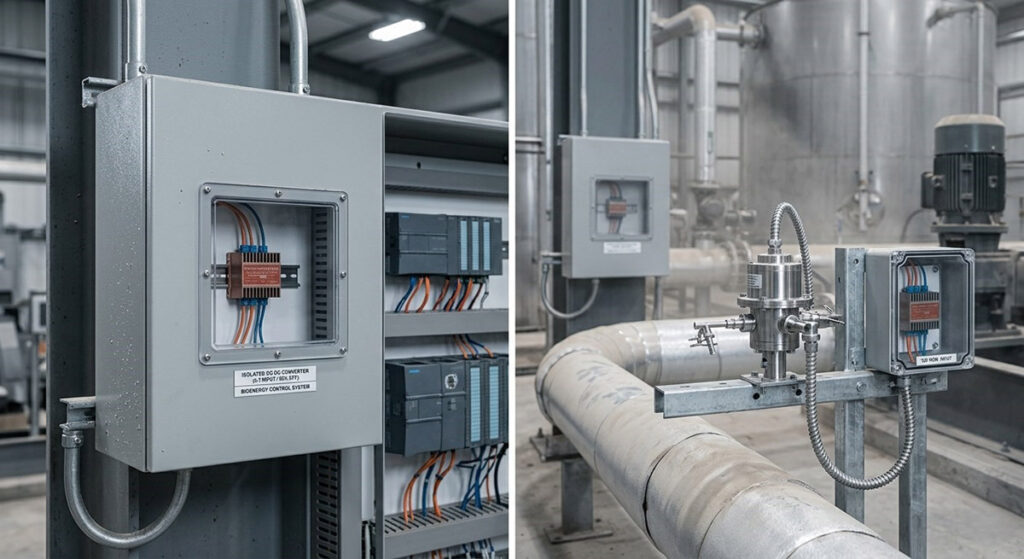
Bioenergy facilities are among the most electrically hostile environments in modern industrial infrastructure — and the monitoring systems holding them together are often the most vulnerable link in the chain.
In this article:
The Harsh Reality of Bioenergy Electrical Environments
Across the United States, the biogas and biomass processing industry is expanding fast. The American Biogas Council estimates that hundreds of new anaerobic digester and biomass projects have come online in recent years, with many relying on distributed power systems and battery-backed controls. But as these facilities scale up, a less-discussed problem is getting harder to ignore: the electrical environment inside a bioenergy plant is rough on sensitive electronics.
Large motor startups, variable loads from generator sets, and the constant switching of industrial automation equipment create voltage dips and surges that ripple through shared DC bus lines. Add high ambient temperatures, airborne particulate from organic processing, and moisture — and you have conditions that can shorten equipment life dramatically. Industry estimates suggest that unplanned electrical downtime in a mid-sized bioenergy facility can cost several thousand dollars per hour when factoring in lost generation revenue, spoiled feedstock, and emergency labor. For the PLCs, IoT sensors, and telemetry gateways that keep these plants running, power quality is not an afterthought — it is a survival requirement.
Why Electrical Isolation Is the Standard, Not an Option
When engineers specify power supplies for industrial control systems, galvanic isolation is the baseline expectation — not a premium feature. The reason is straightforward: in any facility where large motors, inverters, and control electronics share a common ground reference, ground loops are inevitable without isolation. A ground loop creates a path for common-mode noise to flow directly into signal lines, causing erratic sensor readings, PLC faults, and — in worst cases — hardware damage.
An isolated DC-DC converter breaks this loop completely by providing a transformer barrier between input and output. Common-mode transients — the kind generated when a 50 kW motor kicks on — stay on the input side and never reach the sensitive logic running on the output. For biogas sensor networks, remote I/O modules, and communications gateways operating near processing equipment, this protection is what separates reliable operation from chronic nuisance faults.
Selection Criteria #1: Wide Input Voltage Range
Battery-backed DC systems in bioenergy applications don’t sit at a fixed voltage. A 48 V nominal system cycling through charge and discharge can swing anywhere from 42 V under heavy load to 58 V when the charger is actively topping off. Add a solar or wind assist, and the range widens further. A converter with a narrow input window forces designers to add upstream regulation stages — extra cost, extra failure points, extra heat.
| Spec | Value | Practical Meaning |
| Input range | 36 – 75 V | Handles full battery charge/discharge cycle without derating |
| Output regulation | ±1% | Stable output across full input swing |
| Input ratio | 4:1 | Wide enough for solar/wind-assisted storage systems |
A converter covering this full range holds its output stable through every phase of a battery cycle without the designer needing to compensate. That means fewer BOM components, simpler enclosure layouts, and systems that behave consistently whether at 7 AM during a cold grid-charge cycle or 2 PM under peak generation load.
Selection Criteria #2: Thermal Management and 92% Efficiency
Efficiency isn’t just a spec sheet number — it determines whether you can seal a control enclosure or need to cut holes in it. Every percentage point of lost efficiency becomes heat inside your cabinet. At 85% efficiency, a 30 W converter dumps nearly 5.3 W as heat into an enclosed space. At 92%, that drops to 2.6 W — roughly half, which is the difference between a passively cooled sealed enclosure and one that needs a fan, a filter, and a quarterly maintenance visit to clean it.
In particulate-heavy bioenergy environments, cooling fans are maintenance liabilities. Filters clog. Fan bearings fail. A high-efficiency, fanless converter eliminates that entire failure mode. Smaller enclosures, longer MTBF, lower lifecycle cost. American industrial operators are also increasingly tracking energy intensity as part of sustainability reporting — a fleet of distributed converters running at 92% vs. 85% efficiency represents a measurable operational saving across a multi-year deployment.
Selection Criteria #3: Built-in Fault Protection
In a remote bioenergy installation — think a methane capture system at an agricultural digester 40 miles from the nearest service depot — a converter that trips and latches off is a service call. A converter that detects a fault, protects itself, and recovers automatically is an event log entry. That distinction is worth real money.
Four layers of built-in protection:
- Short circuit protection — safeguards against wiring faults during installation or maintenance
- Overcurrent protection — handles unexpected load surges without damage
- Overvoltage protection — absorbs voltage spikes from upstream switching or motor starts
- Overtemperature protection — prevents thermal events caused by blocked airflow or high ambient conditions
These four layers handle the most common field failure scenarios: a wiring fault during installation, an unexpected load surge, a voltage spike from upstream switching, or a thermal event from a blocked airflow path. When the fault clears, the converter recovers — no technician required. For procurement teams, robust onboard protection also simplifies compliance documentation, aligning more cleanly with NEC and UL requirements for industrial control panels.
Application Spotlight: Four Scenarios, One Platform
The same isolated DC-DC converter platform handles a wide range of bioenergy application types. The table below maps common voltage configurations to real-world deployment contexts:
1. Biogas Monitoring Sensors perform with higher accuracy when powered by a clean, isolated source. Isolation eliminates ground-induced offsets that often cause erratic 4-20mA readings. Engineers gain reliable, consistent data for methane concentration and pressure tracking.
2. Remote Telemetry Gateways benefit from the wide input range during peak battery charge or deep discharge cycles. Built-in 1500VDC isolation prevents outdoor lightning surges or cable noise from damaging sensitive communication chips. Reliable data transmission stays uninterrupted even in the harshest field conditions.
3. Industrial PLC Control Cabinets run noticeably cooler and more stable with 92% efficiency modules. By reducing heat dissipation, these converters allow for fanless, sealed enclosures in dusty biomass processing areas. System uptime increases as the risk of thermal-induced logic faults is virtually eliminated.
4. Hybrid Energy Storage Systems respond better to the 4:1 wide input voltage flexibility. Whether dealing with solar-assisted charging or heavy-load motor starts, the regulated output stays rock-steady at 12V or 24V. This protects high-value system controllers and extends the overall lifespan of the connected electronics.
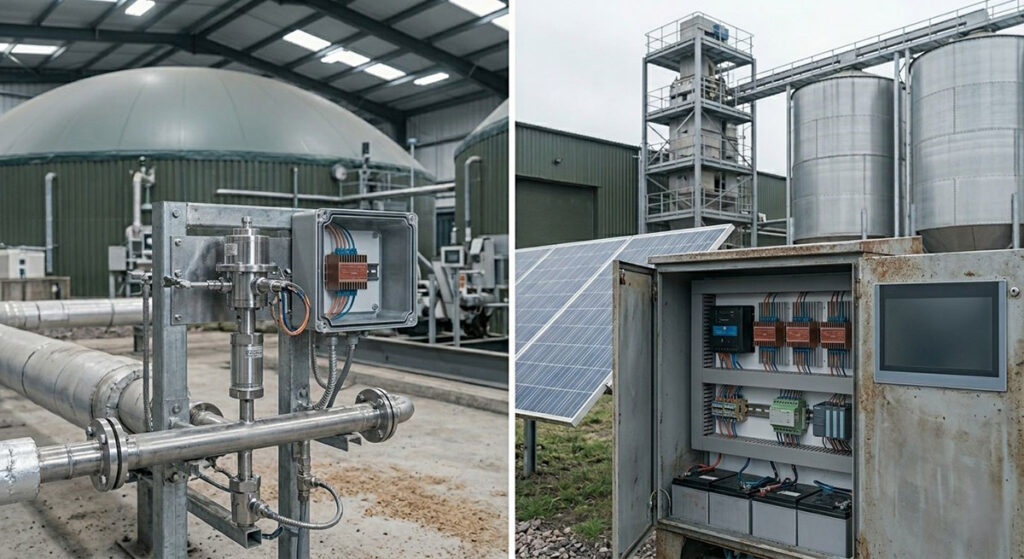
A facility running methane recovery from an anaerobic digester might deploy 48 V converters inside a central control panel while using 72 V variants to power remote sensor nodes along the biogas collection pipeline — all on the same product family, simplifying spares inventory and technician training.
Conclusion
The US distributed energy landscape is shifting. Bioenergy facilities are increasingly integrated with battery storage, microgrid controllers, and grid-interactive inverters — all of which introduce variable bus voltages and tighter requirements on control-side power quality. Choosing a converter platform today with wide input flexibility, high efficiency, and comprehensive fault protection isn’t just solving today’s problem. It’s building a foundation that accommodates tomorrow’s grid-edge complexity without forcing a redesign.
Selecting the right isolated DC-DC converter is less like choosing a component and more like choosing a risk profile. The wrong choice means service calls, downtime, and equipment replacement cycles measured in months. The right choice disappears into the system — doing its job reliably, invisibly, for years.
As the Chief Engineer at PowerHome often emphasizes: ‘In the harsh realities of bioenergy environments, a power converter should never be viewed as a mere electronic component; it must serve as the primary moat protecting sensitive control systems.’ Investing in a platform with wide input voltage and high isolation is, in essence, future-proofing your operations against the grid complexities of the next decade.