
A brand approves a Pantone on a printed proof, the bags arrive in brown kraft, and the colour is wrong. Nobody made a mistake. Brown kraft is a coloured substrate, and no printer can make a Pantone reference match on brown paper what it matches on white.That is the shape of most print complaints on paper bags: not a production fault, but a specification that was never possible in the first place.This part covers the five print processes, how finishing changes the bag, and the part that catches almost everyone: what your destination market legally requires to be printed on the bag itself.
This is the second part of the full paper bags purchase guide by Simmy Lin, Managing Director at BK-Bags, a leading supplier of paper bags and reusable shopping bags, producing in Vietnam and China since 2006.
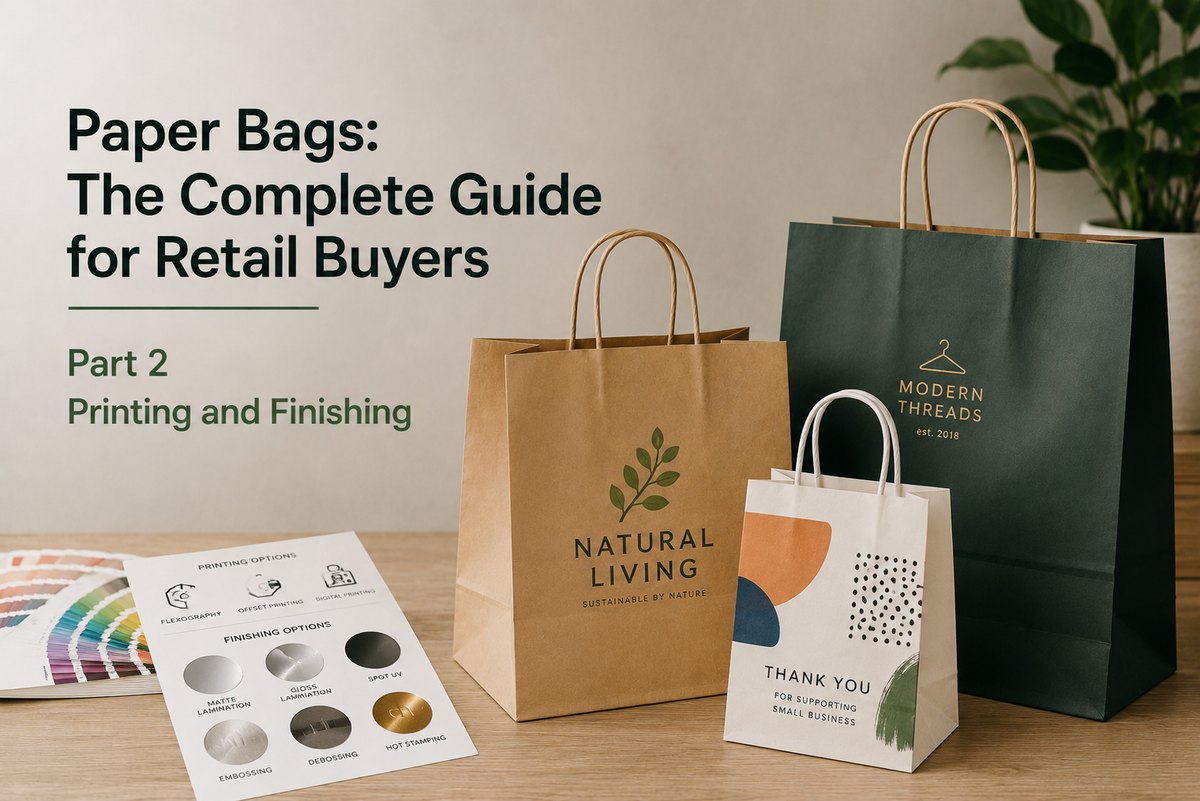
Paper bags are printed by flexography (inline on the bag machine, best for uncoated kraft at volume), offset lithography (sheet-fed on coated stock, the highest fidelity and the route for handmade premium bags), digital (no plate cost, best for short runs and variants), screen printing (heavy spot colour on a finished bag) or rotogravure (very long runs only). Finishing options include BOPP or PET film lamination, water-based varnish, hot foil stamping, embossing and spot UV. Film lamination adds a plastic layer that must be separated in repulping and counts against the EU design-for-recycling grade that applies from 2030, while water-based varnish and embossing keep the bag in the paper stream.
In This Article:
Key Takeaways
- Brown kraft is a coloured substrate. A Pantone will not match what it matches on white stock. Approve color on the production paper.
- The print method is chosen by the substrate, not by preference. Flexo for uncoated kraft on the reel, offset for coated sheets.
- Film lamination is the most expensive decision on the bag, and its cost is recyclability, not just money.
- Embossing adds a premium cue at no recyclability cost. It is the cheapest upgrade available.
- Three markets require specific text or marks printed on the bag itself. California, Japan and, from 2028, the EU.
1. The five print processes
Flexography. Ink transferred from a flexible relief plate, run inline on the bag machine. This is how machine-made kraft bags are printed. It handles rough, uncoated kraft well, runs fast, and costs little per piece at volume. Colour count is limited, screens are coarser than offset, and there is a plate cost per colour. Right for solid logos and spot colours on kraft at production quantities.
Offset lithography. Sheet-fed offset on coated stock. The highest fidelity available: fine screens, accurate Pantone matching, photographic images, gradients. The printed sheet is then laminated or varnished, cut and made up by hand. The standard route for fashion, cosmetics and luxury retail bags. It carries plate and make-ready costs and needs a coated or wood-free surface.
Digital. No plates, so no setup cost, and variable data is possible. Right for short runs, samples and seasonal or regional variants. Unit cost does not fall with volume the way flexo and offset do.
Screen printing. Applied to the finished bag rather than the flat sheet. Useful for a heavy spot colour, a small run, or a position other processes cannot reach.
Rotogravure. Engraved cylinders, very long runs, excellent consistency. Cylinder costs make it uneconomic below very high volumes.
| Method | Colours | Substrate | Economic run | Best for |
| Flexo | 1 to 6 spot, coarse screens | Uncoated kraft, reel-fed | High | Machine-made kraft carriers, food bags |
| Offset | CMYK plus spot, fine screens | Coated, ivory, wood-free, sheets | Medium to high | Premium and handmade bags, photographic artwork |
| Digital | Full colour | Coated and uncoated sheets | Low | Short runs, samples, variants |
| Screen | 1 to 3 spot | Finished bag | Low to medium | Heavy spot colour, awkward positions |
| Rotogravure | Full colour, very consistent | Reel-fed | Very high | Very long runs only |
The process follows the paper, not the preference. A machine-made kraft carrier is a flexo job; a laminated art paper bag with a photographic image is an offset job. Asking for offset quality on a kraft line is asking for something the line cannot do, and paying offset prices for a one-colour logo on kraft buys a capability you will not use.
2. Inks
Water-based inks are standard on kraft and preferred for recyclability. Soy and vegetable-based inks are common on offset work. UV-cured inks give a hard, rub-resistant film and are more difficult in the recycling stream.
If recyclability is part of the brief, put the ink system in the specification rather than leaving it to the printer. It is one of the few places where a genuine environmental improvement costs almost nothing.
3. Colour on kraft, and why proofs mislead
Brown kraft is not white paper. It is a mid-tone brown substrate, and printing ink on it is closer to painting on a coloured wall than to printing on white.
Three consequences follow, and all three surprise buyers. Pantone references shift, and the gap is largest in light, bright and pastel colours, which can effectively disappear. Most flexo bag lines have no white ink, so a design needing white requires a separate opaque white pass that adds a colour and a cost: check before designing around it. And coverage behaves differently, because large solids on uncoated kraft absorb ink and can look patchy.
The rule that avoids all of this: approve colour on the actual production paper. Not a digital proof, not a printed proof on different stock, not a screen. Ask for a printed drawdown on the exact grade and grammage you are buying, and treat that as the approved standard for reorders.
4. Finishing options
Film lamination (BOPP or PET). A plastic film bonded over the printed sheet, in gloss, matt or soft-touch. It gives depth, scuff resistance and water resistance, and it is what most luxury bags use.
Water-based varnish and aqueous coating. Applied inline, gives sheen and rub resistance, stays in the paper stream. Less dramatic than a laminate.
Hot foil stamping. Metallic foil applied with heat and a die. Small foil areas are generally tolerated in recycling. Full-coverage metallised board is a different matter.
Embossing and debossing. Purely mechanical: the paper is shaped between dies. No added material, no recyclability cost, and a genuine premium cue. The cheapest upgrade on this list.
Spot UV. Gloss varnish on selected areas for contrast against a matt background. Adds a cured coating layer.
One practical consequence: if the bag is laminated, water-based glue will not bond to it, so the lamination decision has already chosen a hot-melt adhesive. Finishing decisions are never isolated.
5. What finishing costs you in recyclability
This is where a good-looking bag quietly becomes a difficult one.
Film-laminated paper carries a plastic layer that has to be separated during repulping. Water-based coatings disperse in water and let the fibre be reclaimed straightforwardly, while polyethylene and polypropylene film need additional separation.
Europe now measures this rather than arguing about it. That matters because of what is coming under the PPWR:
| Date | Requirement |
| 1 January 2030 | Packaging must meet design-for-recycling criteria and be graded A to C |
| 1 January 2035 | Recyclability must be demonstrated at scale |
| 1 January 2038 | Only grades A and B permitted on the EU market |
A film-laminated paper bag with a plastic rope handle is carrying two separate penalties into that grading. A varnished, embossed kraft bag with a twisted paper handle is not.
The practical version for a buyer: if you can get the look with an embossed, varnished, uncoated stock instead of a film laminate, you have removed a compliance argument you would otherwise keep having for the next decade. If the brand genuinely needs the laminate, make that decision knowingly, and ask the supplier for a recyclability test result rather than an opinion.
6. What the market requires printed on the bag
This is the section that catches almost everyone, because it is not a design decision or a compliance footnote. It is an artwork specification, and it has to be in the file before plates are made.
| Market | What must appear on the bag itself | From |
| California | Manufacturer name, country of manufacture, and the percentage of post-consumer content | In force since 1 January 2026 |
| Japan | The 紙 (kami) identification mark, in Japanese, on the packaging itself | In force. Corrugated and non-aluminium beverage cartons excluded |
| European Union | Harmonised material composition labelling | 12 August 2028 |
| France | Triman logo and sorting information | In force |
California is the strictest and most recent. Under SB 1053 the bag must carry the manufacturer’s name, the country of manufacture and the post-consumer percentage. If that percentage changes between orders, the artwork changes with it. Japan requires the 紙 mark in Japanese on the packaging itself, and it is the single item most often missed by suppliers outside Japan.
Build these into the artwork brief at the start. Adding a legally required line after plates are cut means new plates.
7. Artwork and pre-press checklist
Before you release a file:
- Vector artwork for logos and type, at final size, fonts outlined
- Correct colour space: Pantone references for flexo and screen, CMYK plus named spots for offset
- Trapping and minimum line weights confirmed with the printer, because flexo on kraft cannot hold what offset on coated stock can
- Bleed and safety margins confirmed against the die line, not guessed
- The die line itself, showing panels, gussets, bottom fold and turnover, so nothing critical lands on a crease
- Any legally required text for the destination market, from section 6
- A named person who approves the production drawdown
8. Ten questions to ask your supplier
- Which print method, and is it printed on the reel or on sheets?
- How many colours are included, and are they Pantone matched?
- Can the line print opaque white, and does it count as a colour?
- What is the plate or cylinder cost per colour, and who owns the tooling after the first order?
- Can I approve colour on a drawdown printed on the actual production paper?
- Which ink system: water-based, soy or UV?
- Film lamination or water-based varnish? If film, which film?
- Can you provide a recyclability test result, ideally against the Cepi test method?
- Can you supply the die line before artwork is finalised?
- Will you confirm in writing that the artwork carries the market-specific marks required for my destination?
“The print problems we see are almost never printing problems. Someone approved a colour on the wrong paper, or a legally required line was added after the plates were made, or a brand asked for photographic quality on a kraft line that was never going to give it. All three are settled in a ten minute conversation before the file is released. None of them are fixable afterwards.”
Simmy Lin, Managing Director, BK-Bags
FAQ
Which printing method is best for paper bags? It depends on the substrate and the run length, not on preference. Flexography prints uncoated kraft inline on the bag machine and is the low-cost option for solid spot colours at volume. Offset lithography prints coated stock in sheets and gives the highest fidelity, full colour and accurate Pantone matching, and is the route for premium handmade bags. Digital printing has no plate cost and suits short runs, samples and variants. Screen printing applies a heavy spot colour to a finished bag. Rotogravure is only economic at very high volumes.
Why does my Pantone colour look wrong on a kraft bag? Because brown kraft is a coloured substrate, not white paper. A Pantone reference printed on white coated stock and the same reference printed on brown kraft are different colours, and no printer can make them match. The gap is largest in light and pastel colours. This is physics rather than a production fault. Approve colour on a drawdown printed on the actual production paper, and expect a brand colour to need a separate approved kraft standard.
Are laminated paper bags recyclable? Film-laminated paper bags carry a plastic layer that has to be separated during repulping, and water-based coatings are considerably easier to reclaim than polypropylene or polyethylene film. Europe now measures this with the Cepi recyclability laboratory test method, with an evaluation protocol from the 4evergreen alliance. Under the PPWR, packaging must meet design-for-recycling criteria from 1 January 2030 and only grades A and B are permitted from 2038, so a laminate is a decision with a decade-long consequence. Ask for a test result rather than an opinion.
What is the alternative to laminating a premium paper bag? A water-based varnish for sheen and rub resistance, embossing or debossing for a tactile cue, and a small hot foil area if the brand needs metallic. That combination keeps the bag in the paper stream, avoids the design-for-recycling penalty, and often costs less than a soft-touch laminate. It will not match a laminate for water resistance, which is the one property genuinely worth paying for.
What has to be printed on a paper bag for California? Under California SB 1053, in force since 1 January 2026, a recycled paper bag supplied at checkout must have printed on the bag itself the name of the manufacturer, the country where the bag was manufactured, and the percentage of post-consumer content. The bag must also be curbside recyclable and contain at least 40% post-consumer content, rising to 50% from 1 January 2028. This is an artwork requirement, so it has to be in the file before plates are made, and the artwork changes if the post-consumer percentage changes.
What is the 紙 mark on Japanese packaging? It is the paper identification mark required under Japan’s Act on the Promotion of Effective Utilization of Resources. Paper containers and packaging sold in Japan must display it on the packaging itself, in Japanese, with corrugated board and non-aluminium beverage and liquor cartons excluded. It is the item most often missed by suppliers outside Japan and belongs in the artwork brief from the start rather than being added late.