
For twenty years the answer to a tariff problem in paper bags was to move the order to another country. In July 2024 that stopped working. The United States now has antidumping duty orders on paper shopping bags from eight countries at once, with countervailing duties on top for two of them. Vietnam and China are both on the list.Meanwhile the customs duty on paper bags into the EU, the UK and Japan is zero, and has been for years. In those markets the cost of entry is not duty. It is compliance.This part covers both: what your certificates actually prove, what each market now requires, and what it costs to land the goods.
This is the third part of the full paper bags purchase guide by Simmy Lin, Managing Director at BK-Bags, a leading supplier of paper bags and reusable shopping bags, producing in Vietnam and China since 2006.
FSC certification proves responsible forest sourcing and an audited chain of custody. It does not prove recycled content, and it does not by itself satisfy the EU Deforestation Regulation. Customs duty on paper bags (HS 4819.30 and 4819.40) is zero into the United States, the European Union, the United Kingdom and Japan under the Uruguay Round zero-for-zero agreement on pulp and paper. The United States is the exception in practice, because antidumping and countervailing duty orders issued on 18 July 2024 cover paper shopping bags from nine countries at company-specific rates
In This Article:
Key Takeaways
- FSC is not recycled content. A US state carryout bag law asks for post-consumer content, which FSC virgin kraft does not provide.
- FSC is not EUDR compliance. Standard chain of custody carries no plot-level geolocation.
- The FSC claim has to be on your invoice, with a claim type and certificate code, or your order is not certified.
- PPWR has applied since 12 August 2026, including PFAS limits on food-contact packaging with no grace period.
- US antidumping rates are company-specific. Ask your exporter for its own case rate in writing.
- Duty into the EU, UK and Japan is zero, so the EU-Vietnam trade agreement gives you nothing on paper bags.
1. FSC, and what the certificate proves
FSC is the Forest Stewardship Council, which sets standards for responsible forest management and audits the supply chain behind a product. On figures FSC published in 2025, more than 171 million hectares of forest were certified and around 70,000 organisations held a chain of custody certificate.
There are three product labels, and they are not interchangeable.
| Label | What it means |
| FSC 100% | All virgin material from FSC-certified forests |
| FSC Mix | FSC virgin fibre, recycled material and FSC Controlled Wood combined, usually shown with a percentage |
| FSC Recycled | 100% recycled fibre, verified as genuinely recycled rather than simply claimed |
PEFC is the other major scheme and works on the same logic, with a different logo and licence. Do not let a supplier substitute one for the other without telling you.
Chain of custody, and the line on your invoice
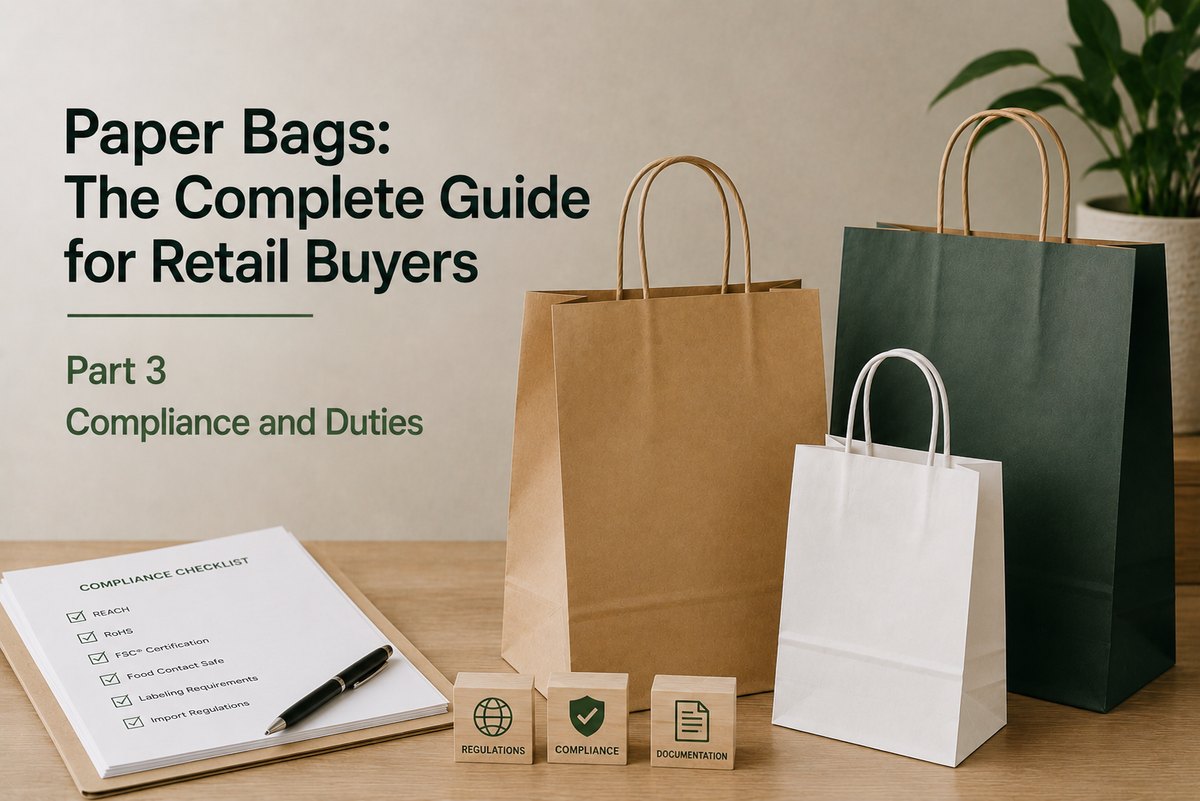
The certificate that matters is not the forest certificate. It is chain of custody, governed by FSC-STD-40-004: an unbroken chain of certified organisations covering every change of legal ownership from the forest to the company selling you the bag.
The test most buyers never apply: the FSC claim has to appear on your invoice, and it has to be specific. Not “FSC certified” but a claim type plus certificate code against the line item, for example FSC Mix 70%, FSC-C000000. A certificate on a wall does not make your order certified. The claim on the paperwork does, and you can check the code in the FSC public database in a minute.
The two things FSC does not do
FSC is not recycled content. FSC Mix and FSC 100% can be entirely virgin fibre. US state carryout bag laws ask for a percentage of post-consumer recycled material, and an FSC 100% virgin kraft bag fails that while being perfectly certified. They are separate specifications and both belong on the purchase order.
FSC is not EUDR compliance. The EU Deforestation Regulation requires the operator placing goods on the EU market to file a due diligence statement including geolocation of the harvest plots. FSC’s own position is that certification strengthens the evidence but does not replace due diligence, and standard chain of custody carries no plot-level geolocation. FSC offers a voluntary Regulatory Module. Treat FSC as an input to your due diligence file, not as the file.
2. European Union
PPWR
The Packaging and Packaging Waste Regulation, Regulation (EU) 2025/40, has applied since 12 August 2026. Four parts matter for paper bags.
PFAS in food-contact packaging. From 12 August 2026, food-contact packaging over the Article 5(5) limits cannot be placed on the EU market: 25 µg/kg for any individual PFAS, 250 µg/kg for the sum, 50 mg/kg total. No grace period, no sell-through of existing stock. PFAS were widely used as grease repellents on paper, so any grease-resistant bag needs a written declaration.
Design for recycling. From 1 January 2030, packaging must meet design-for-recycling criteria and is graded A to C. From 1 January 2038, only A and B are permitted. Film lamination and non-paper handles both work against that grade.
Labelling. Harmonised material composition labelling applies from 12 August 2028.
Recycled content mandates apply to plastic packaging. There is no equivalent quota for paper under the PPWR.
EUDR
Paper packing containers under HS 4819 are in EUDR Annex I. The Commission’s May 2026 review package confirmed the dates: 30 December 2026 for large and medium companies, 30 June 2027 for micro and small enterprises.
The scope question is frequently got wrong. Packaging used exclusively to support, protect or carry another product is out of scope. Carrier bags imported and sold as goods in their own right are in scope, which is exactly what a retail paper bag order is. The obligation sits on the EU operator placing them on the market, which is your company, not your supplier. What you need from the supplier is traceability data back to the harvest plots.
Germany’s VerpackG registration and France’s AGEC and Triman obligations are separate from the PPWR and apply on top.
3. United States
State carryout bag laws touch the product itself. California’s SB 1053 took effect on 1 January 2026 and is the strictest. Covered stores may only offer recycled paper bags at checkout, at a charge of at least 10 cents, and plastic carryout bags are gone regardless of thickness.
A “recycled paper bag” under the amended statute must be curbside recyclable in a majority of Californian households; carry printed on the bag itself the manufacturer’s name, the country of manufacture and the percentage of post-consumer content; and contain at least 40% post-consumer material now, rising to 50% from 1 January 2028.
Washington requires 40% post-consumer content or wheat straw. New Jersey and Massachusetts require 40%, with 20% for bags rated at 8 lb or less. Thresholds differ, so check the specific state.
Extended producer responsibility. Seven states now have packaging EPR laws covering paper: Maine, Oregon, California, Colorado, Minnesota, Maryland and Washington. As of August 2026 only Oregon and Colorado have live producer fees, with California and Oregon reporting feeding fee calculations from 2027.
PFAS and claims. State food-packaging PFAS bans keep expanding, with Illinois in force from 1 January 2026 and Kansas from 2027. The FTC Green Guides remain in their 2012 form with a revision pending, and enforcement on unqualified “recyclable” claims has tightened. A paper bag with a plastic handle and a film laminate marketed as “100% recyclable” is exactly the claim that gets challenged.
“California is the one that catches people on timing. The post-consumer percentage is a furnish decision and the printed line on the bag is an artwork decision, and both are settled months before anyone asks us for a certificate. By then the bag either complies or it does not, and no document issued afterwards changes that.”
Simmy Lin, Managing Director, Bk-bags
4. Japan
The identification mark is a printing requirement. Under the Act on the Promotion of Effective Utilization of Resources, paper containers and packaging must carry the 紙 (kami) identification mark, in Japanese, on the packaging itself, with corrugated board and non-aluminium beverage cartons excluded.
Containers and Packaging Recycling Law. The obligated business is the entity using or selling the packaging in Japan, so the cost and the filing sit with your Japanese customer or importer, not with the overseas supplier. Expect to be asked for material composition data.
Japan’s mandatory charge on plastic shopping bags, introduced in July 2020, does not apply to paper. That asymmetry is a large part of why Japanese demand for paper carriers has been strong.
5. Where paper bags actually come from
China is the largest paper producer in the world, at roughly 31% of global output, and the largest exporter of paper packing containers. The United States is the largest producer of pulp for paper, and Brazil, Chile and Uruguay have driven most of the recent growth in pulp supply. FAO figures published in December 2025 put world wood pulp production at 189 million tonnes in 2024.
On paper shopping bags specifically, the cleanest public data comes from the US Department of Commerce.
| US imports of paper shopping bags | 2020 | 2022 | Change |
| China | $233.9m | $336.9m | +44% |
| Vietnam | $74.3m | $143.9m | +94% |
| India | $11.9m | $65.6m | +453% |
| Cambodia | $1.8m | $14.8m | +740% |
China was still by far the largest supplier, at more than twice Vietnam, while every alternative origin grew much faster because buyers were already diversifying. Those origins made up around 65% of US paper shopping bag imports in early 2023, which is why the trade case covered eight countries in one action rather than one.
Vietnam’s own largest source of imported paper is China. Country of origin tells you where the bag was converted, not where the fibre came from.
Bk-bags converts in both Vietnam and China, and on any order those stay two separate questions: the origin drives the duty, the fibre drives the certificate.
6. Duties and taxes
Position as at 26 August 2026. The general US tariff layer changed four times in the first eight months of 2026. Confirm on the day you order.
Customs duty is zero almost everywhere
Under the Uruguay Round “zero-for-zero” agreement on pulp and paper, the major developed markets eliminated tariffs on paper products. That still holds.
| Destination | Customs duty on HS 4819.30 / 4819.40 |
| United States | Free (General rate; Column 2 is 35%) |
| European Union | 0.00% third country duty |
| United Kingdom | 0.00% third country duty |
| Japan | Free under the WTO rate (General rate 4.6%) |
Because the EU duty is already zero for everybody, the EU-Vietnam Free Trade Agreement gives you nothing on paper bags. There is no preference to claim, because there is no duty to remove. The same applies to CPTPP and RCEP into Japan.
The United States is the exception
On 18 July 2024 the US issued antidumping duty orders on certain paper shopping bags from Cambodia, China, Colombia, India, Malaysia, Portugal, Taiwan and Vietnam, and countervailing duty orders on China and India. Turkey was handled on a separate schedule earlier in 2024.
The rates are company-specific.
| Country | Antidumping | Countervailing |
| Vietnam | 36.51% for named separate-rate exporters; 92.34% Vietnam-wide entity | none |
| China | 73.05% for named exporters; 146.32% China-wide entity | 41.46% all others, up to 172.36% by company |
| India | 0.00% to 4.59%, some higher | 2.38% to 4.81%; 3.39% all others |
| Cambodia | 7.07% all others | none |
| Malaysia | 3.18% all others | none |
| Taiwan | 4.74% all others | none |
| Portugal | 6.14% | none |
| Colombia | 11.06% all others | none |
The critical point. Vietnam and China are non-market-economy cases, so there is no “all others” antidumping rate. An exporter without separate-rate status receives the country-wide rate: 92.34% for Vietnam, 146.32% plus countervailing duties for China. The question that matters is not “where is this made” but “what is your company’s case rate, and can you put it on the pro forma.”
The scope, and the three exclusions
The orders cover paper shopping bags with handles of any type, at least 4.5 inches wide and 2.5 inches deep, made of cellulose fibre, paperboard or pressboard at less than 300 gsm. Twisted paper, flat paper, yarn, ribbon, rope, string, plastic and die-cut handles are all inside the scope.
Three exclusions exist:
- Bags of 1/6 or 1/7 barrel size (11.5 to 12.5 inches wide, 6.5 to 7.5 inches deep, 13.5 to 17.5 inches high) with flat paper or die-cut handles
- Bags with die-cut handles, under 86 gsm, and under 11.5 inches high
- Bags with non-paper handles made wholly of woven ribbon or similar woven fabric, and finished with folded tops, tied knots or t-bar aglets. The order states expressly that braided or twisted materials such as rope or cord do not qualify
These are real design routes, not loopholes, and a bag genuinely outside the scope is outside the duty. But the written scope is dispositive, not the HTS code, so take customs advice on a specific bag rather than reading a table.
The general tariff layer
The Supreme Court struck down the IEEPA tariffs on 20 February 2026 and a Section 122 surcharge ran to 24 July 2026. From 24 July 2026, Section 301 forced-labor tariffs took effect on 60 economies at 10% or 12.5%, with 12.5% for both China and Vietnam, subject to exemption annexes checked per HTS code. Pre-existing China-specific Section 301 duties still apply.
Do not plan against any general tariff number. Plan against the antidumping case rate, which is stable, and have your broker confirm the rest on the day.
7. Eight questions to ask your supplier
- Which certificate: FSC or PEFC, and what is the certificate code?
- Which claim type will appear on my invoice: FSC 100%, FSC Mix with a percentage, or FSC Recycled?
- Will the claim and code be printed on the commercial invoice, mapped to the line item?
- What percentage of the fibre is post-consumer recycled, separately from any FSC claim?
- If I import into the EU: what traceability data can you provide toward EUDR due diligence, including harvest geolocation?
- Can you supply a PFAS declaration against the PPWR Article 5(5) limits, and a food-contact declaration if the bag touches food?
- Does the artwork carry the marks my destination market requires?
- Shipping to the United States: what is your company’s specific antidumping and countervailing case rate, in writing, and are you a separate-rate exporter?
“Buyers ask us for FSC and think the conversation is finished. Then a California programme needs forty percent post-consumer and the FSC bag does not have it, or an EU importer needs geolocation and the chain of custody certificate does not carry it. The certificate is real and it is worth having. It just answers one question, and most programmes are asking three.”
Simmy Lin, Managing Director, Bk-bags
FAQ
What is FSC certification and why does it matter for paper bags? FSC sets standards for responsible forest management and audits the supply chain behind certified products. There are three labels: FSC 100%, FSC Mix and FSC Recycled. What matters commercially is chain of custody: a specific claim such as “FSC Mix 70%” plus the certificate code appearing on your invoice.
Does FSC certification mean the bag contains recycled paper? No, and this is the most expensive confusion in paper bag procurement. FSC 100% and FSC Mix can be entirely virgin fibre. Recycled content is a separate specification. US state carryout bag laws require post-consumer recycled content, not forest certification: California requires 40% now and 50% from 1 January 2028, so an FSC-certified virgin kraft bag fails that while being perfectly certified.
Does FSC certification satisfy the EU Deforestation Regulation? No. The EUDR requires the operator placing goods on the EU market to submit a due diligence statement including geolocation of the harvest plots. FSC’s own position is that certification strengthens the evidence but does not replace due diligence, and standard chain of custody carries no plot-level geolocation. Paper packing containers under HS 4819 are in Annex I, and carrier bags imported and sold as goods are in scope, from 30 December 2026 for large and medium companies.
Does the PPWR require recycled content in paper bags? No. The PPWR recycled content mandates apply to plastic packaging only. What it does require of paper bags is compliance with the Article 5 substance restrictions, including the PFAS limits on food-contact packaging that applied from 12 August 2026 with no grace period, design-for-recycling grading from 1 January 2030, and harmonised material labelling from 12 August 2028.
Do US antidumping duties apply to paper bags from Vietnam and China? Yes. Since 18 July 2024 the US has had antidumping duty orders on certain paper shopping bags from Cambodia, China, Colombia, India, Malaysia, Portugal, Taiwan and Vietnam, with countervailing duty orders on China and India. Rates are company-specific: Vietnam 36.51% for named separate-rate exporters and 92.34% Vietnam-wide, China 73.05% and 146.32% China-wide plus countervailing duties. Because both are non-market-economy cases there is no all-others rate, so ask any supplier for its own case rate in writing.
Which paper bags fall outside the US antidumping scope? The orders cover bags with handles of any type, at least 4.5 inches wide and 2.5 inches deep, under 300 gsm. Three exclusions exist: barrel-size bags with flat paper or die-cut handles; die-cut handle bags under 86 gsm and under 11.5 inches high; and bags with handles made wholly of woven ribbon or similar woven fabric that also have folded tops, tied knots or t-bar aglets. Braided or twisted rope does not qualify, so a PP rope handle creates no exclusion. The written scope is dispositive, not the HTS code.
What import duty is charged on paper bags into the EU and Japan? None. Under the Uruguay Round zero-for-zero agreement on pulp and paper, the major developed markets eliminated tariffs on paper products. The EU third country duty on HS 4819.30 and 4819.40 is 0.00%, the UK the same, Japan Free under the WTO rate, and the US General rate Free. The EU-Vietnam Free Trade Agreement therefore gives no benefit on paper bags: there is no duty to remove. In these markets the cost of entry is compliance, not duty.